Art & Collection
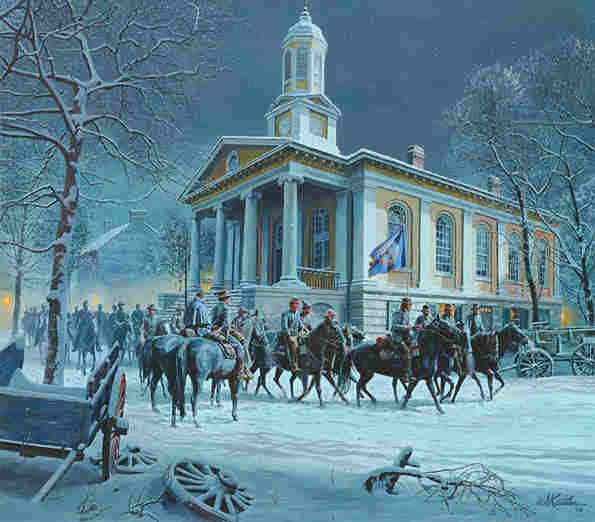
Bravest of the Brave
Black Horse Cavalry · Warrenton, Virginia · February 22, 1863
by Mort Künstler · Official 1999 Snow Print
Image size: 18" × 20½". Overall size: 24" × 25½".
1,700 Limited Edition numbered and signed. 100 Artist Proofs numbered and signed.
26 BHCM (Black Horse Cavalry Memorial) Edition numbered and signed.
Click to view larger image
Description of the Black Horse Cavalry
In their care was placed the fate of a new nation. They composed a single company of the 4th Virginia Cavalry — but they were better known as the Confederate "Black Horse Cavalry." Raised in Virginia's Fauquier County, they had answered the Southern call to arms in 1861, and had immediately distinguished themselves in combat.
At the Battle of First Manassas, their hammer-like strike against Federal troops at Cub Run had helped turn the Northern retreat into a panicky rout. Their calm courage under fire eventually earned them a unique post of honor: scouts and protective escorts for the commander of the Army of Northern Virginia, General Robert E. Lee, and his irreplaceable "right arm," General Stonewall Jackson.
In the winter of 1862–63, their wartime duty had become personal: the war had come to their homes. A mammoth Northern army had poured into their native counties in a campaign to destroy Lee's army. Now, as the scouts of Lee's army, the Black Horse Cavalry did double duty, mounting repeated reconnaissance patrols, pinpointing Federal positions — and thus defending their homeland.
Deep snows and winter downpours left the roads in the Warrenton region almost impassable at times, but the Black Horse Cavalry always found a way through. When high waters flooded the region's waterways, they found a way across. When food and forage were dangerously low, they kept going.
On February 28, 1863, General Lee officially cited them for their efforts and sacrifices. The "bravest of the brave" — the Black Horse Cavalry — had lived up to their name.
Mort Künstler's Comments
In 1990, the idea of painting the Black Horse Cavalry was proposed to me for the first time. In the intervening years the suggestion has been continually repeated. Finally, in November 1998, I went to Warrenton, Virginia, and met with Lynn Hopewell, the resident expert on the Black Horse. I learned that this famous cavalry unit was a pre-war cavalry company, raised in Warrenton, Fauquier County, Virginia in 1859. Capt. John Scott was the company's first organizer and first commander.
As Mr. Hopewell graciously showed me all the points of interest in Warrenton, I was immediately struck by the charm and beauty of the town. Of all the structures in Warrenton, the one that jumped out at me was the Courthouse. The present building is the fourth structure on the site, which replaced the third structure built in 1854. That building was burnt down in 1889 in an accidental fire started by bonfires celebrating election returns. Fortunately, the present Courthouse, still in use, was rebuilt from the old plans and on the old walls so that it looks very much like the Civil War era structure.
It then became apparent to me that the most dramatic way to show off the black horses was against white. I came up with the idea of snow and bright moonlight which also set off the white and yellow of the Courthouse.
Sgt. Robert Edward Martin, the second rider from the right, is silhouetted against the light in the window of the Courthouse. He was presented with a fine rifle, a gift of an admiring Englishman, as being the bravest man in Lee's Army. Martin thus became the "Bravest of the Brave."
Based on the knowledge that the troop was in Warrenton during the winter of 1862–63 and constantly on patrol, we checked with James Robertson, Jr., distinguished alumni Professor at Virginia Tech for a suitable date. He confirmed there was a snowfall on February 22, 1863.
I hope this painting calls attention to one of the South's most beautiful Courthouses and gives more recognition to the Black Horse Cavalry, "The Bravest of the Brave."