Mildred Lee “Minnie” Martin
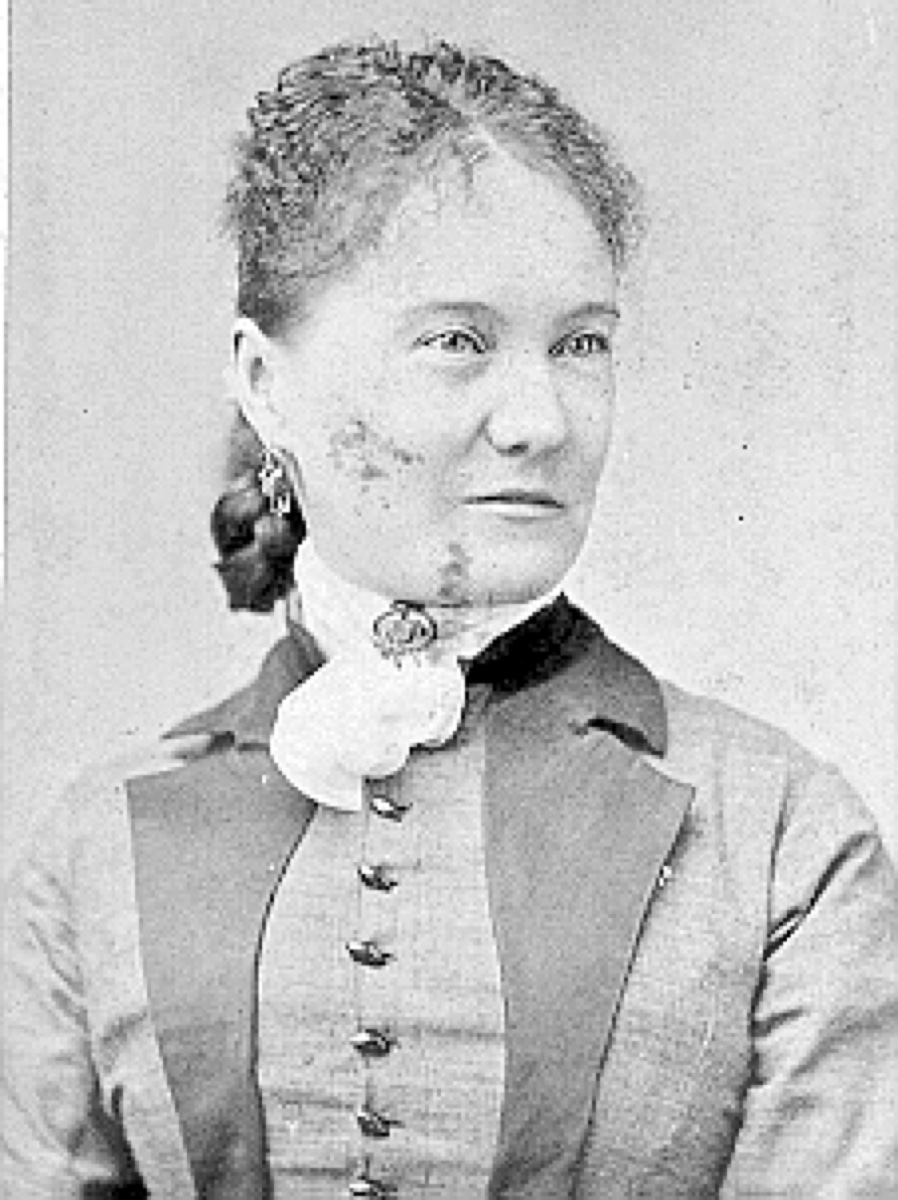
Mildred Lee “Minnie” Martin was born 21 March 1838. Named after her aunt Mildred Martin Shumate, Minnie Martin never married and died 30 November 1919, at the age of 81.[365] [366]
Successive censuses show her living at the home farm, which she seems never to have left. In 1880, after the deaths of her parents, she was still living there with her brother Josh and two others, Annie F. Whitehead, a school teacher, and cousin; and Nathanial W. Pope, also teaching school.[367] Thirty years later, in 1910, with her brother Josh dead, she was still living with her cousin, Annie, but now, with two servants, William Allen and Susan Allen.[368]
Her Love Affair with William H. Childs
William H. Childs was a neighbor and the brother of James H. Childs who married Minnie’s sister Margaret and of Mary Virginia Childs who married Minnie’s brother Bob.
At one time, William was a member of the Virginia legislature.[369] They lived only a few miles apart, but conducted much of their romance through the mails. Many letters from Minnie to him survive in the Childs family records. The following one is typical. When she was 37 years old, about 4 months before her father’s death, she wrote this letter.[370]
Thursday night, March 11, 1876 My dear William Your dear letter reached me safely tonight, oh how my heart did leap with pure joy when the letter was handed to me, and my dear one, you know the pleasure it gave me to hear from you, one who is so dear to me. You can guess how much disappointed I was in not seeing you last Monday. But first, as you said in your letter, I had so many with me and I didn’t want them either. I expected it was for the best that you didn’t come to the Station, I will think so at least. I had a big cry when I got home. I felt very sad indeed I feel that way very often. You say that you saw me. I didn’t have the pleasure of seeing you. Mrs. Holtzclaw sent down to the Station after me to come by and take supper with her. Said she wanted to see me on business, but I declined going for I didn’t feel like it. Mary was anxious to go, but I didn’t want to go. I was right sick next day, but am much better now. I tried to get something for you in Warrenton that I thought would ___ you, but I couldn’t find any. We met with Mr. Grant on our way home. He insisted on us coming down to see them. Said any time we would come he would meet us at the Station & go down with us, but don’t know when we can go. You wanted to know my views about marrying for money. I think that is the cause of so much unhappiness in married life. It’s owing to the fact that so many marry for money. And when poverty comes in the door love goes out the window. I don’t think there is much love when they marry alone for money. I don’t think I could ever be happy to marry alone for money. You wanted to know who Mr. Bowen was speaking of - he meant? Mr. Bradley and you know better don’t you my ever dear one. I know you do. You say you will tell me something when you see me but please don’t’ forget it & what was it about. I bet you something I can guess, don’t you think so? I received a letter from Dick [her brother, John Richard Martin, living in Missouri] this evening. He wrote me his little girl [his fiancée, Jemima, who he would marry exactly one month later and who was twelve years his junior], as he calls her, is quite ill with fever & was as low as could be. Her sister wrote for him to come on immediately to see her that her life had been despaired of. Says he has been missing her greater portion of the time & feels almost broken down. Says he is a most excellent nurse. Says we must not blame him for not coming on the 1st of the month but must be attributable to the working of Providence. Says he had a talk with her physician & and he thinks she will be well enough towards the last of the month by good nursing to accompany him to Virginia. Dick writes like he is very much distressed and of course he is if he loves her and I think he does. You must excuse bad writing this time for my eye hurts me very badly tonight - feels like something was in it – hope it will be all right soon. I know I haven’t written you a good letter, but will try and do better next time if I can. I must now say good by, dear one, good by. Take good care of yourself. May God bless you. The next time I have a good dream I will write you. You know what I mean by saying a good dream, -the next time I dream of you. Good night and may you have pleasant dreams. Lovingly yours, M.
A family tradition says that a wedding was arranged but, William got cold feet at the very last minute. She was also going to marry Seldon Johnson. The wedding breakfast had been served. But, his brothers put him on a train to Western Virginia, where he stayed to become a pharmacist. The brothers thought Minnie had too disagreeable a personality.[371]
Minnie inherited a piece of her father’s Home Farm, including the old family home, from her brother Josh, and lived there until she died. Her nephew, Ernest Lee Childs looked after her affairs.
Minnie’s Death
Although she loved, Minnie never married. Forty two years later, her obituary read:
Miss Mildred M. Martin died suddenly at her home near Casanova on Sunday, November 30th at an advanced age. The funeral was conducted by Rev. W[illiam]. G. Pendleton.[372] Miss Martin was the last but one of a large family, a daughter of the late Mr. and Mrs. John Martin of this county. Her four[373] brothers were members of the Black Horse company and among many brave men were noted for their reckless courage. Miss Martin was a woman of exemplary character, bright mind and interesting personality and will be greatly missed in her neighborhood. She is survived by one sister, Mrs. William Bowen, a nephew, Mr. E. L. Childs, and one niece living in the west.[374]
Minnie’s Will
In her will[375] she divided the land into six parcels and divided them among friends and relatives. She had a close relationship with the Allen and Moore families. She left 25 acres, “the Kentucky Field,” To William Allen and his grandson Harry. She left the bulk of her property including a five-acre plot with her house, all its contents and garden land to her servant and companion, Susan Allen, daughter of William, who was raised on the farm. Susan married Peter Moore.
Susan Moore (colored) wife of Peter Moore, and daughter of William Allen, who now lives with me and is my employ, and has been raised on my place, always being a splendid servant, faithful and capable, in consideration of her fidelity, care and attention to me during these years, I give and devise to her, said Susan Moore, absolutely and unconditionally, my house, yard, garden and orchard, the twelve, (12), acres lot adjoining the Kentucky field on the south, and the seven,(7), acres spring lot to the west of the house,…being a portion of my farm derived from the estate of my brother, G. W. Martin.
Mildred left five acres to her friend and cousin Annie F. Whitehead who lived with her for many years.
Interestingly, she left ten acres to “my friend Selden Johnson of Roanoke, Virginia.” This is the man who, according to family tradition, suddenly left town after their wedding breakfast. Apparently, their friendship survived.
She left her remaining land to her niece Mamie Martin Burge, wife of James Burge. Mamie sold it a few years later. Mamie was noted as living in Jacksonville, Illinois. Interestingly, she did not mention her brother Dick’s daughters, Lucy and Bettie, by his first marriage. To carry out the land divisions in her will, her property was surveyed and recorded in Fauquier land records.[376]
Mildred left her brothers’ war relics, in trust, to R. Scott Carter.
I give the three, (3), sabers, the picture of my brother and the bullet with which my brother, G. W. Martin, a confederate soldier, was shot by Captain Meigs of the Union Army after he had surrendered as a prisoner to my brother, and my brother, after receiving what was thought to be a mortal would, fired and killed Meigs. I request my friend, Scott Carter, to present these things which he has to the Confederate Museum in Richmond for preservation.[377]
Susan Allen Moore died in 1963 at age 88 and willed[378] the home to her daughter Anna Moore Craig, who was 45 at the time. Anna owned the house[379] until her death in 2001,[380] but did not occupy it. From 1990- 1999, the house was occupied by Thomas F. Jenkins, a friend of the Craig family.[381] [382] The house burned to the ground in the fall of 2001.
The “Cousin Hugh” in the nearby photograph must have been a cousin from her Mother’s side of the family. There was no known Hugh on her father’s side.