Dick Martin, Courier and Scout
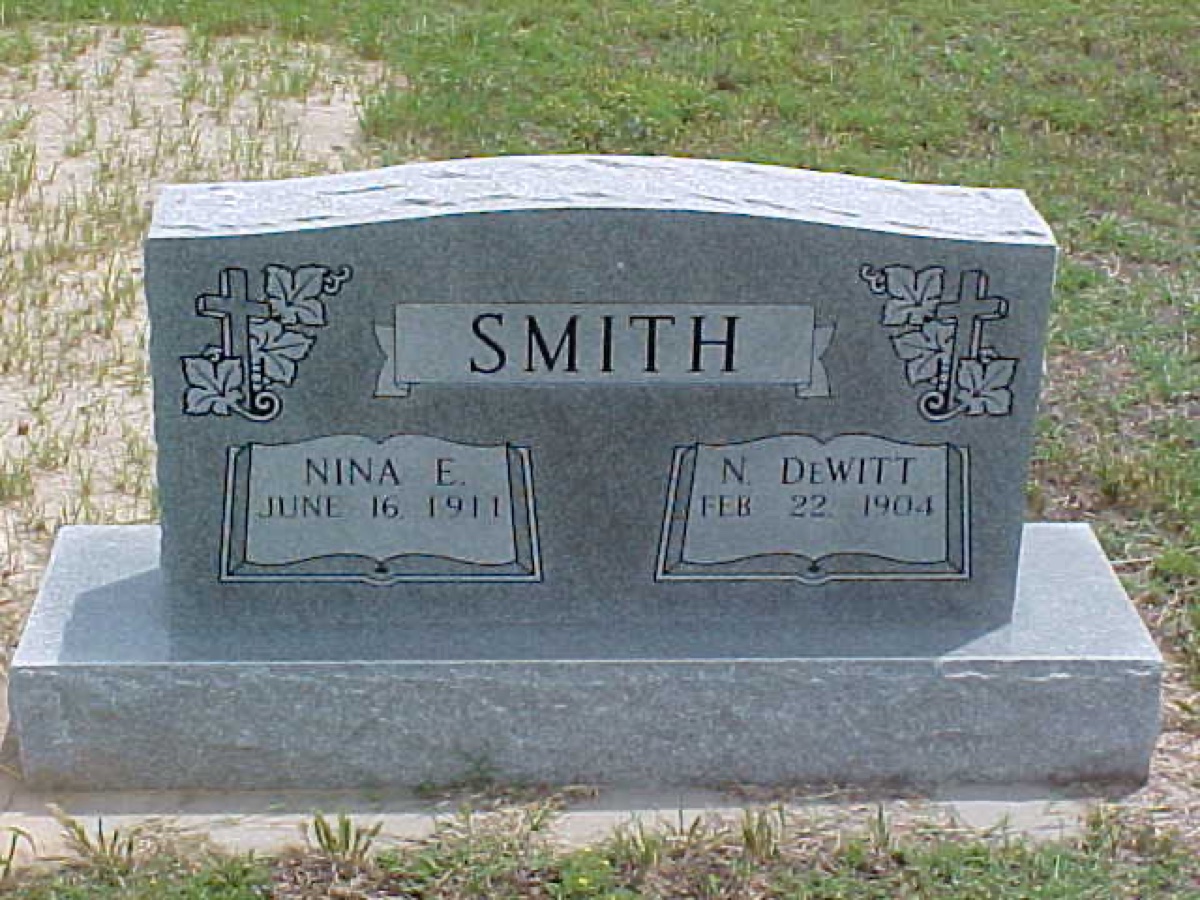
Of all the children of John and Susan Martin, we know the most about their son Dick. Of the three brothers, only he had surviving descendants.
Dick was the middle brother of the Martin boys. He was born 9 July 1841 in Fauquier County, a twin to his sister Susan Elizabeth. He attended school in nearby Warrenton. Just before his 17th birthday, he inscribed a textbook on algebra and another on geometry and trigonometry, “J. Richard Martin, January 30, 1860, Warrenton Male Academy.”[65]
He was almost 20 when the war began. He left Fauquier County shortly after the war and spent almost 50 years in Missouri, marrying twice. He came home to die in Fauquier at the age of 74, 5 January 1916.[66] He was the last of his brothers to survive. The nearby chart shows his family.
Dick Martin’s Black Horse Service
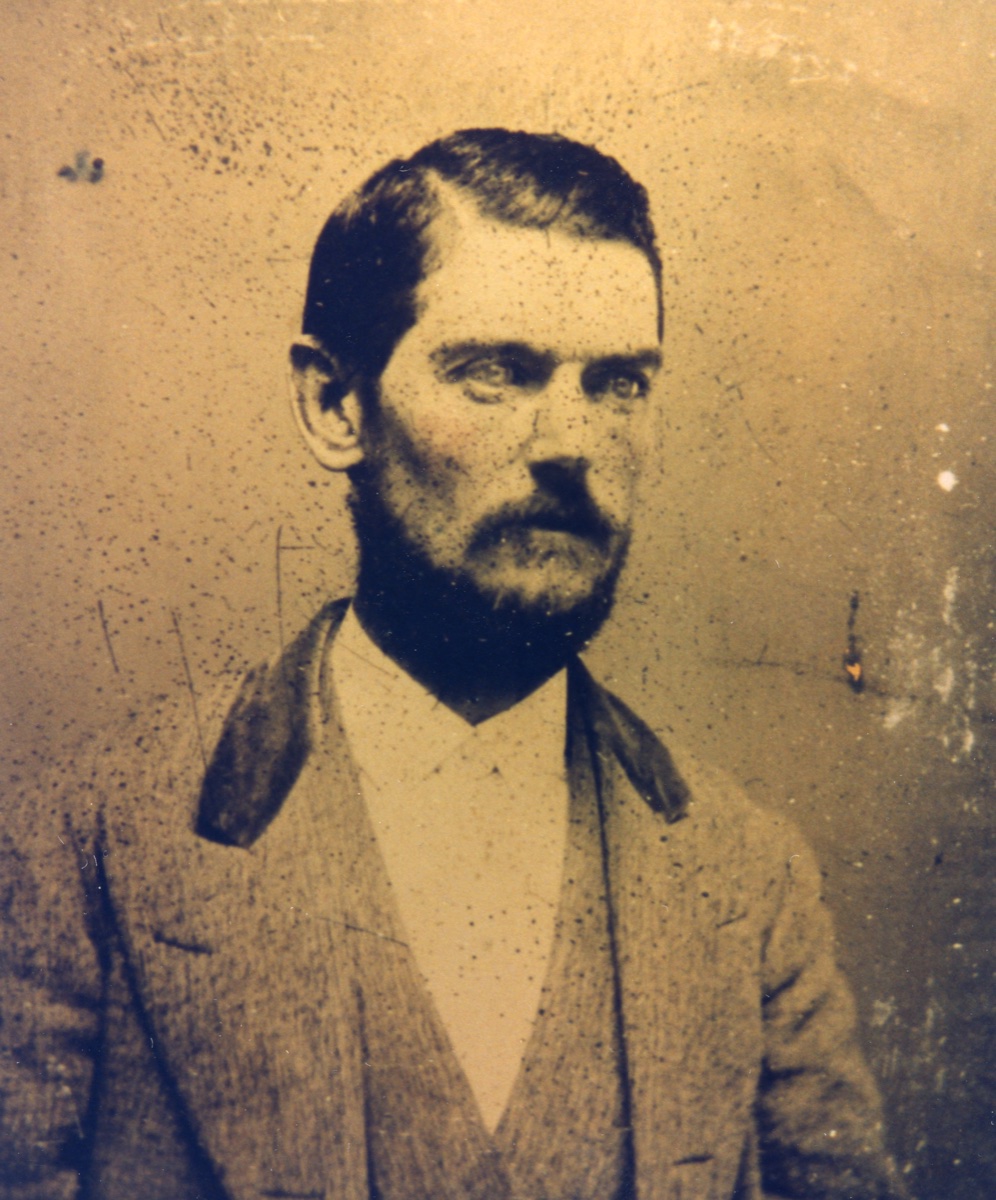
His Confederate Service Record shows that “he enlisted 25 April 1861; 20 years old; detailed with Genl. Taylor Nov. to Dec. 1863; detached as Scout Sept. to Oct. 1863; scouting for Genl. Fitz Lee Jan. to Feb. 1864; w. May
White House; paroled 18 May 1865 at Winchester.” [67] A list published
shortly after the war noted “Wounded at the White House, May 1864. Removed to Missouri.”[68]
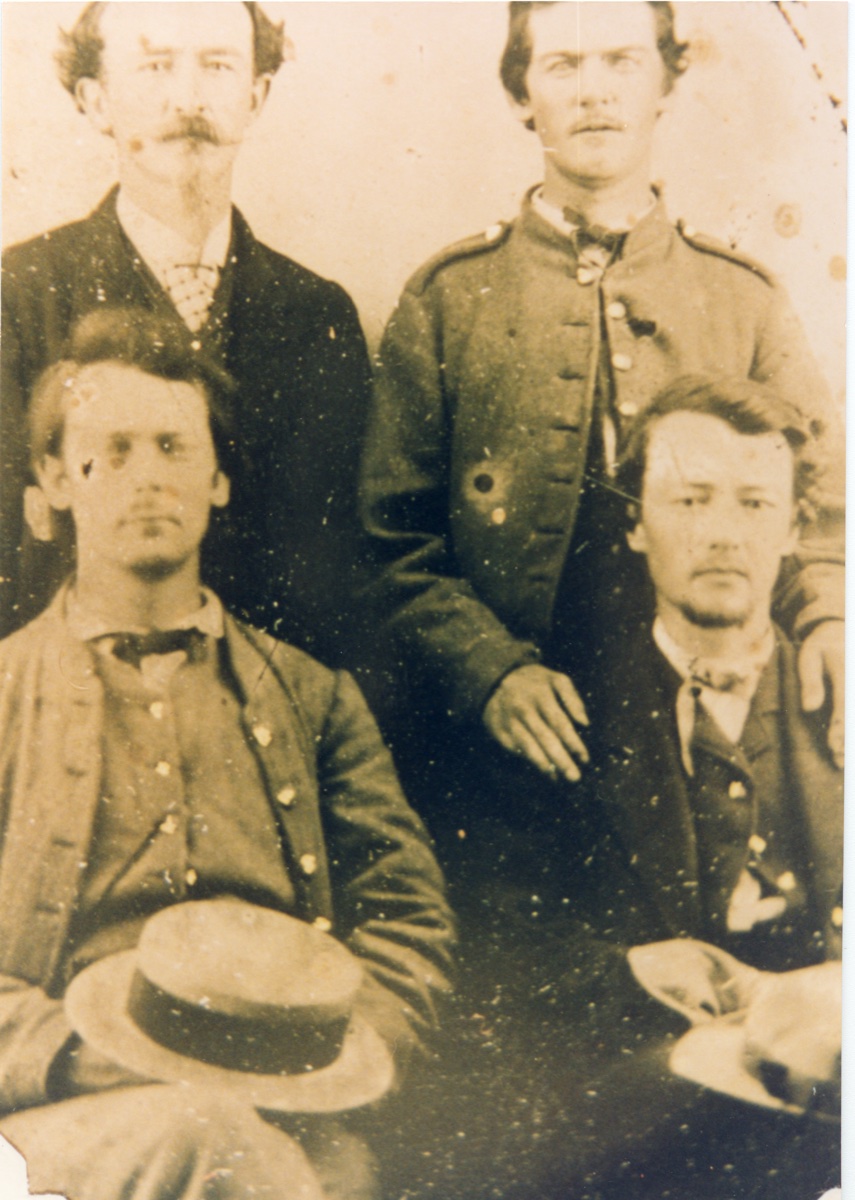
In his Confederate pension application,[70] he said he was “shot through the wrist and in breast and above hip.” He took part in the battles of “Bull Run, Second Manassas, Chancellorsville, Wilderness, 7 days fight around Richmond, [unreadable] Harpers Ferry, Haws Shop, Appomattox, Gettysburg.” Alexander Hunter said of him: [71]
Dick Martin …was second to none in the Black Horse for courage and nerve. It was he who had the proud distinction of being chosen by Jackson at Harper’s Ferry to carry to Lee the tidings of its surrender. It was he whom Lee chose to bear his dispatches to Jackson, urging him to effect a junction at Sharpsburg. Dick performed his mission well; but he killed his thoroughbred horse in doing so.
In another book, Hunter said: [72]
Dick Martin …had an encounter with some of the Blue Blouses that will point a moral even if it does not adorn a tale. Dick at that time was a harum scarum fellow of about twenty, a born scout who was always seeking adventures, and loving hazard for danger’s sake. One day he was prowling in the woods on foot near an infantry camp when he saw half-dozen soldiers leave their quarters and make their way down a branch. This excited his curiosity, and he followed them for about a mile, then they halted and Dick wondered what they were up to. He was not kept long in suspense. They gathered together under a large tree, took off their coats, spread an oilcloth on the ground, disgorged several bottles, next a deck of cards and a box of bone chips. Then after taking
a smile’ all round, they sat themselves down tailor fashion and began to deal the cards. Then Dick knew that they were indulging in that fascinating pursuit known as draw poker. Dick’s curiosity changed into a deep interest, for he was an expert in that game, as many of the Black Horsemen found out to their sorrow, so he edged himself to a clump of briars within a few feet of the players. They were so intensely absorbed in the game that they did not look up, save when the bottle was passed around, then Dick’s mouth would water, and it required all his self-control to refrain from rushing forward and taking a swig himself. So the forenoon wore away and the man in the bushes noticed that the chips all gravitated one way, and hands went into pockets and greenbacks were handed over to buy more chips from the pile, but they would gravitate as at first, and as the passion of greed and gaming, fed by the liquor, rose in each breast the stakes grew larger and the betting fiercer. Nothing was heard but the mysterious words: ‘Jack pot, Kitty! Raise you! Pass! One card; two cards; three cards. Flush; full house; and constantly the chips were scooped up by one man, who retailed for cash, until the winner had a big wad of the green on the grass, upon which he placed a bottle to keep the notes from blowing away. Finally Dick got tired, and jumping to his feet he cried:Surrender! Hands up!’ Now, if Satan himself, with horns, hoof and tail, smelling with sulfur, with eyes of flame, had jumped in the ring, he could not have created more dismay. The players’ hands went up spasmodically, and they seemed turned into stone and sat there, stolid, motionless, and stared and stared with mouths agape. Dick’s words eased the situation.Gentlemen,’ he said, making a courtly bow, for your real highwayman is always polite,I don’t mean any harm, but I’m playing a lite hand and want that pile.’ It was silently handed him by the winner, and at this the losers perked up, the color came to their cheeks, the light to their eyes, the open mouths closed in a grin, and then opened again in convulsive laughter, all except the winner. He couldn’t see the point in the joke. One of the players handed Dick the bottle and he took “a smile,” a very long one indeed, and then disappeared in the bushes. He did not search the other men. I never knew a Black Horseman to rob a prisoner, but I am bound to confess that I did not know the Black Horsemen who would have let that Yankee gambler walk off with his ill-gotten gains. This was a combination of righteousness that would lead one to expect that the conscience fund of the War Department would be enriched to the amount that he cabbaged from that Yankee sport, but Dick was not that kind of hairpin Christian.
Randy Carter’s diary tells of another incident involving Dick Martin:
This in winter of 1863. 2 Black Horse men attempted to capture Gen. Switzer’s [Weitzel’s?] payroll at old Ficklin House on West side of road near Bealeton towards Midland. (Now, a yellow frame house.) They got thru lines and up to house, where they told guard to disarm, but he did not speak English and Dick had to shoot him, upsetting the plot and scaring the General’s wife to death thinking Mosby’s men were there to capture them.[73]
Another comrade noted:[74]
“After the capture of Mr. Stone, Dick Martin (now living in Missouri) was designated to patrol the same road. While Martin was not so prudent as his predecessor, he was equally courageous and was never so much pleased as when he met with the enemy’s scouts; by some manner of evasion one or two Yankee scouting parties passed up the road and returned unmolested. Capt. Randolph hearing of this notified Martin that if he was not more vigilant he would be replaced. This nettled Dick and he notified his squad to meet the next morning at Garnett Embrey’s by daylight; (only six of whom responded) after the purpose was stated, bidding adieu to Garnett and the “Old Pullet”, Garnett‘s pet name for his wife, and the girls, we traveled at a rapid rate to about a half mile of …”
His Move to Missouri
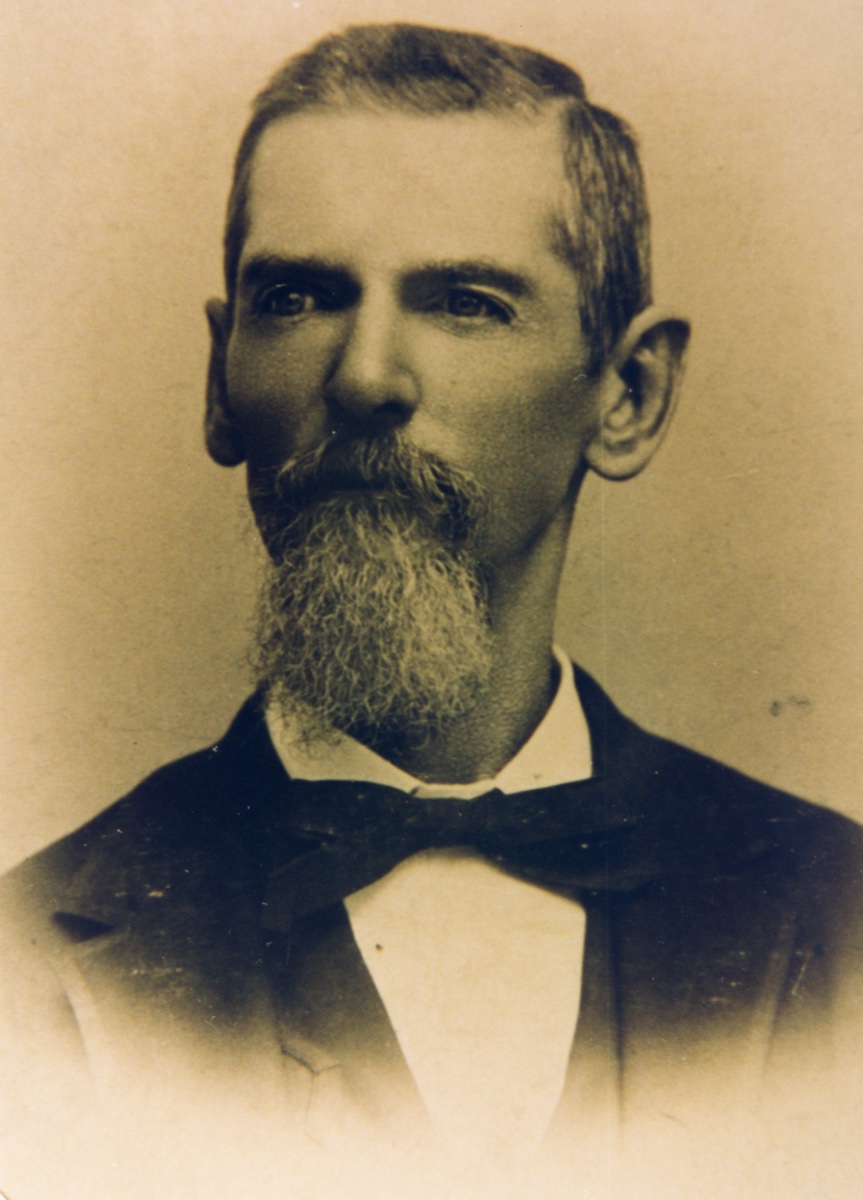
According to a newspaper sketch, [presented later in this chapter] He began teaching in Virginia in 1866, having charge of private schools for two terms of ten months each.[75] When he was about 26, he moved to Missouri.
“For a short period he was in the Mercantile business at Rappahannock Sta. after the close of the war, but a devastated country afforded very little promise for a livelihood, and he sought the fertile, and prosperous State of Missouri, where he turned his attention to the education of the young, and stood well as a teacher …”[76]
A comrade put it a little differently:
“After the war Dick immigrated to Missouri, became a schoolmaster, got converted, dropped his evil ways and married, and became an estimable citizen and pillar of the church.”[77]
He lived in various places around Fulton, Callaway County, Missouri, including Pike, Montgomery and Audrain Counties.[78] All were within a sixty-mile radius of Pike County. He settled down in Fulton, and had a long career there as a school teacher. In 1913, at the age 72, he was described as the “oldest teacher in the Kingdom of Callaway.”[79] He was a pretty good schoolteacher—according to his granddaughter; he was excused from the regular testing then required of teachers.
He married twice and had three daughters. First, he married Jemima Gilmore eleven years after the war. They had two daughters, Lucy and Bettie. Bettie never married. Lucy‘s son, DeWitt Smith, died, aged 99 in 2003, in Siloam Springs, Arkansas. He had no surviving children.
Dick and Jemima divorced and he married Mary Gregory who had been married twice before and who had two children from these earlier marriages. Dick and Mary had one child, a daughter, Mamie. Mamie’s daughter Aileen, aged 90 in 2005, lives in Jacksonville, Illinois.
Dick’s Marriage to Jemima Gilmore and their Children
Dick married Jemima Gilmore, 11 April 1876, in Pike County, Missouri.[80] [81] She was 22 and he was 34, 12 years her senior. Jemima was born 28 March 1854 near Bowling Green, Missouri.[82] Jemima seems to have had no middle name, but her nickname was “Pinkie.” It was so much a part of her, that she was listed on her marriage certificate as “Pinkie J. Gilmore.” Six months before their marriage, Dick asked Pinkie’s mother for her hand in marriage:
Concord, Callaway, Co. Mo October 22, 1875 Mrs. Lucy A. Gilmore My dear Mad’m. It behoves me to inform you, that a matrimonial engagement has existed between your daughter (Miss Pinkie) and myself since February last; and I now respectfully ask of you the hand of your daughter in marriage. Should this request meet with your approbation, it is my desire to marry as soon after my school closes at this place, as I can suit our convenience; and start immediately on a tour to Virginia to see my parents.[83] I promise that nothing shall be wanting on my part, to make your daughter comfortable and happy, and I will not make my future home at any place where she is not entirely satisfied or pleasantly situated. Soliciting your sanction of my request, I am yours, very respectfully, J. Richard Martin[84]
The letter was addressed to Lucy A. Gilmore at Ashley, Pike County, Missouri.
Lucy A. Gilmore’s father was John J. Gilmore who was born 19 March 1805 in South Carolina. He was a Civil War soldier and died during the war in 1864.[85] Lucy’s mother was Lucy Ann France Bird Greenwood, born 29 May 1824, in Clark County, Kentucky and died 3 April 1892.[86]
Dick and Jemima had two daughters, Bettie Bowen Martin and Lucy Ann Martin.[87]
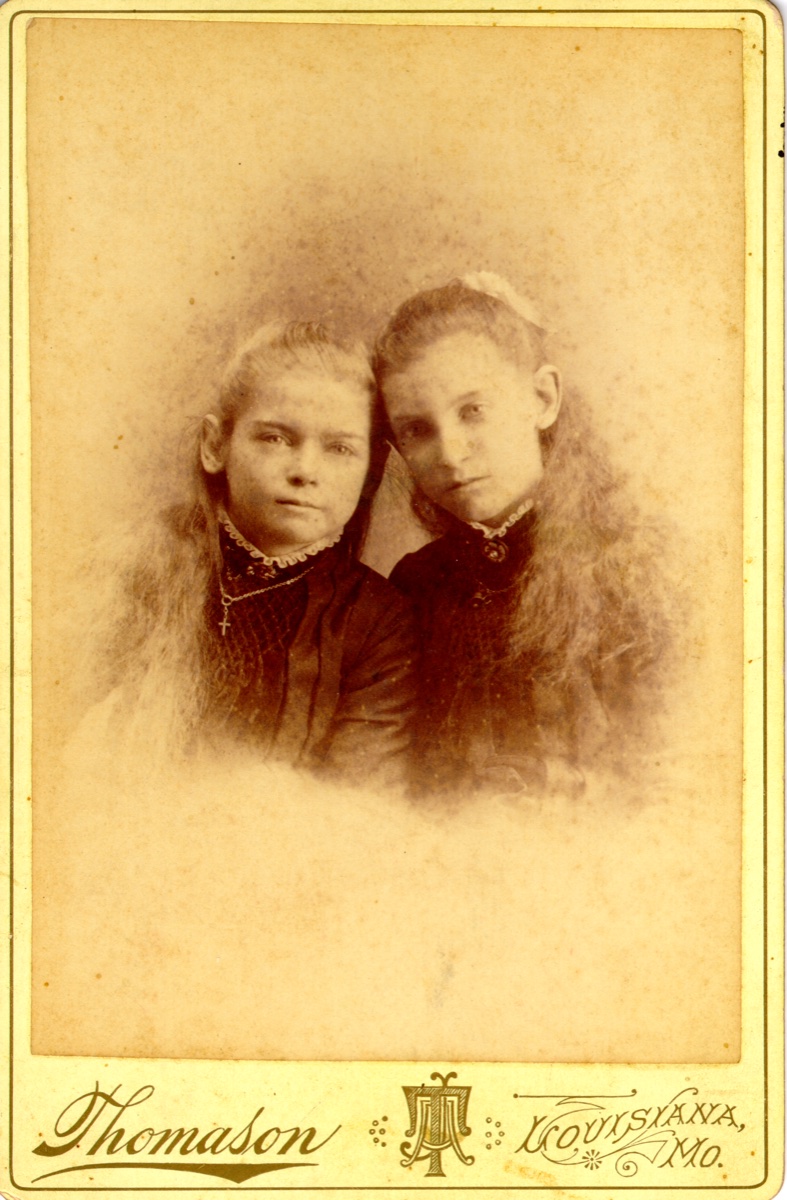
In 1877, Dick and Jemima sold his interest in a portion of the Licking Run farm that his father gave him.[88] Their residence was in Callaway County. He was careful to keep the family graveyard intact; “Reserving however, from this sale, the site of the graveyard or burial ground on said premise as now located containing one half acre to the proper use of the parties of the first part & their heirs forever.”
According to the 1880 census,[89] they had moved again and were living in neighboring Montgomery County, southeast of Audrain County, Missouri. Dick was teaching school. Jemima’s Marriage to Charles Kinney
Apparently Dick and Jemima divorced in the early 1880s before his marriage to Mary Gregory. In 1883, seven years after their marriage, it appears that Dick was now separated from Pinkie. From 70 miles away, he wrote this plaintive note to his daughters, who were four and six:[90]
Concord Mo Sept 10 1883 My Dear Lucy and Bettie Your dear Papa wants to see his dear little girls very much and hopes they are well, and good little girls. Papa hopes he may see all you soon, & would love so much to have them join with him to go to school. He has several little girls about your age, going to school & they can read & write. Oh, how I do wish you could write so as to write to me. Be good little girls & may God bless you both. Papa
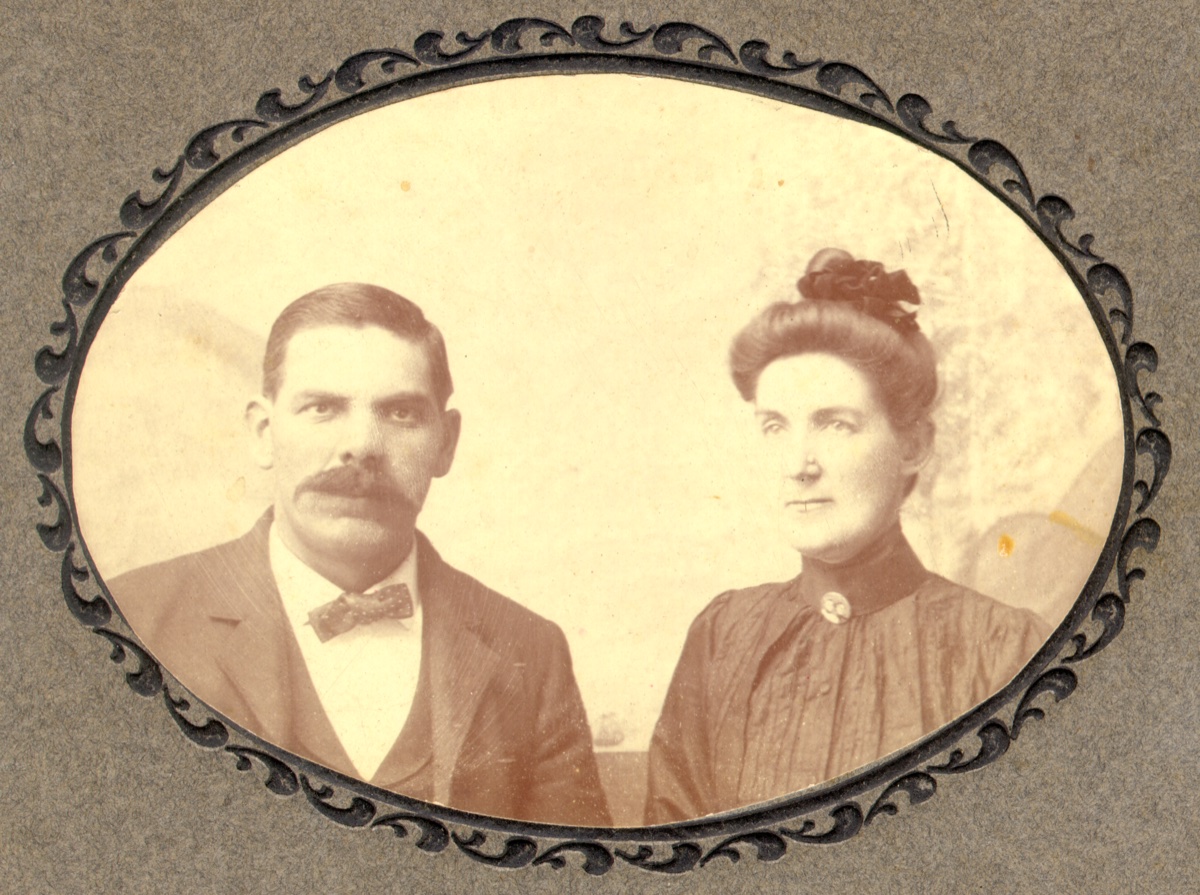
Jemima’s Marriage to Charles Kinney
Seven and a half years after the letter to Dick’s daughters, on 24 May 1891, in Pike County, a pastor of the Methodist Episcopal Church, S. D. Kendall, married Jemima and Charles O. Kinney.[91] Charles was born in West Point, Hancock County, Illinois, on 16 November 1864. His father was Joseph Kenny, born in Buffalo, New York. His mother was Ann Graham,[92] born in Illinois.[93] On her marriage certificate, Jemima said she was from Bowling Green, Pike County, Missouri. Charles was 26 and Jemima was 37, 11 years older. Jemima’s daughters were now 11 and 13.
In 1900, both daughters, Lucy and Bettie, were living with their mother and step-father in Bowling Green, along with Joseph R. Kinney, aged 12, Charles’ son from a previous marriage. Lucy was a schoolteacher. Bettie’s occupation was listed as “housework.” Charles and Jemima owned a mortgaged farm.[94]
Their Move to Owasso
In the 1910 census, the family was found in Owasso, Tulsa County, Oklahoma. From Bettie’s obituary we learn that they moved there in 1901.
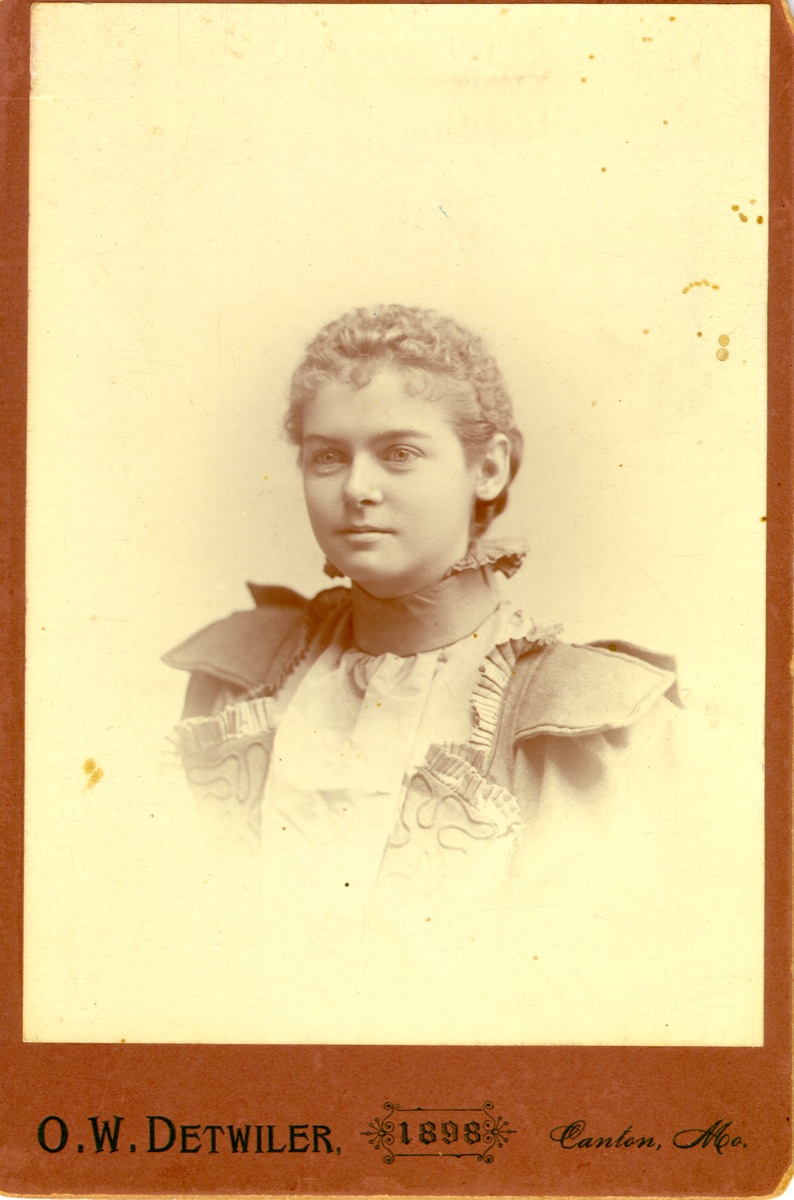
Lucy and her sister Bettie began teaching at a new school where Lucy met her future husband, Nat Smith.
The City of Owasso is one of the oldest existing communities in Tulsa County. Owasso is a Cherokee word meaning “trail’s end” or “end of the trail”. The community of Owasso was so named because it was, at that time, the terminus in the Indian Territory of the Atchison, Topeka and Santa Fe Railroad. The first building in Owasso was the A.T. & S.F. Railroad depot. In the year 1900, Messrs. Dyer, Preston Ballard and Nat D. Smith [Nathanial DeWitt Smith] began a campaign to raise funds for the erection of a school building and church. Messrs. Robertson, Smith and Frank B. Finch are credited with sawing blocks from the Bird Creek bottoms for the foundation of the building. Mose Monroe was the carpenter who constructed the building and N. D. Smith was the new school’s first teacher. That year, 47 pupils paid $1.00 a month to attend the subscription school. Before the second term started, Misses Lucy Ann and Bettie B. Martin moved to town with their mother and stepfather, C. 0. Kinney, and began teaching [at] the school. In 1909, bonds were voted for a new brick schoolhouse which was erected in 1910- 11. Hayward H. Haden, Nat Smith and Boon F. Gray composed the first school board and Dan M. Setser was the first principal. In 1919, two one-room districts voted to join the Owasso District No. 14. With the consolidation, Owasso became the largest consolidated school district in America, encompassing 62 square miles.[95]
Charles and Jemima operated the Place Hotel in Owasso. [96]
C.O. Kinney in 1903 built a 17 room hotel. Perhaps not as pretentious or elegant as modern day structures but just as serviceable. The growth of the area because of the railroad brought business people and potential residents to this new city. As the school system grew, school teachers also boarded at the hotels. The location of the hotel was on Broadway just east of the First Nation Bank building. The Palace Hotel was destroyed by fire in 1907.
Need a brief sketch of Jemima and one of Charles to go here. He operated grocery in Edmonds. Did Jemima teach? Where? Etc.
[Insert photo of Nat Smith.]
Charles, Jemima and Betty Move to Edmond, Oklahoma
Charles and Jemima prospered in Owasso and had a department store. He served as mayor of Owasso. However for some reason, they became unhappy with living there.
They moved for one year to San Diego, California, but according to Lucy’s son, they didn’t like it there. In 1921 they moved to Edmond, Oklahoma County, Oklahoma, a suburb of Oklahoma City, some 100 miles from Owasso, because Bettie didn’t want to teach in Owasso anymore.[97] Nathaniel and Lucy stayed in Owasso.
Deaths of Charles and Jemima Kinney
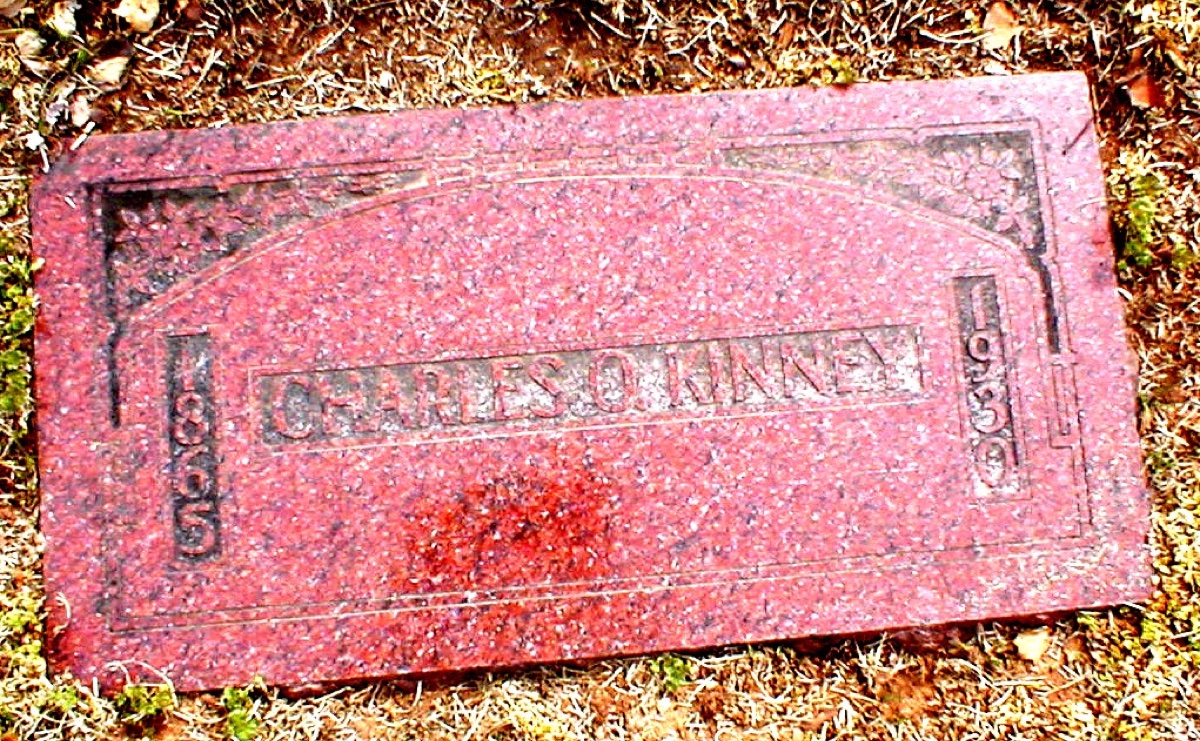
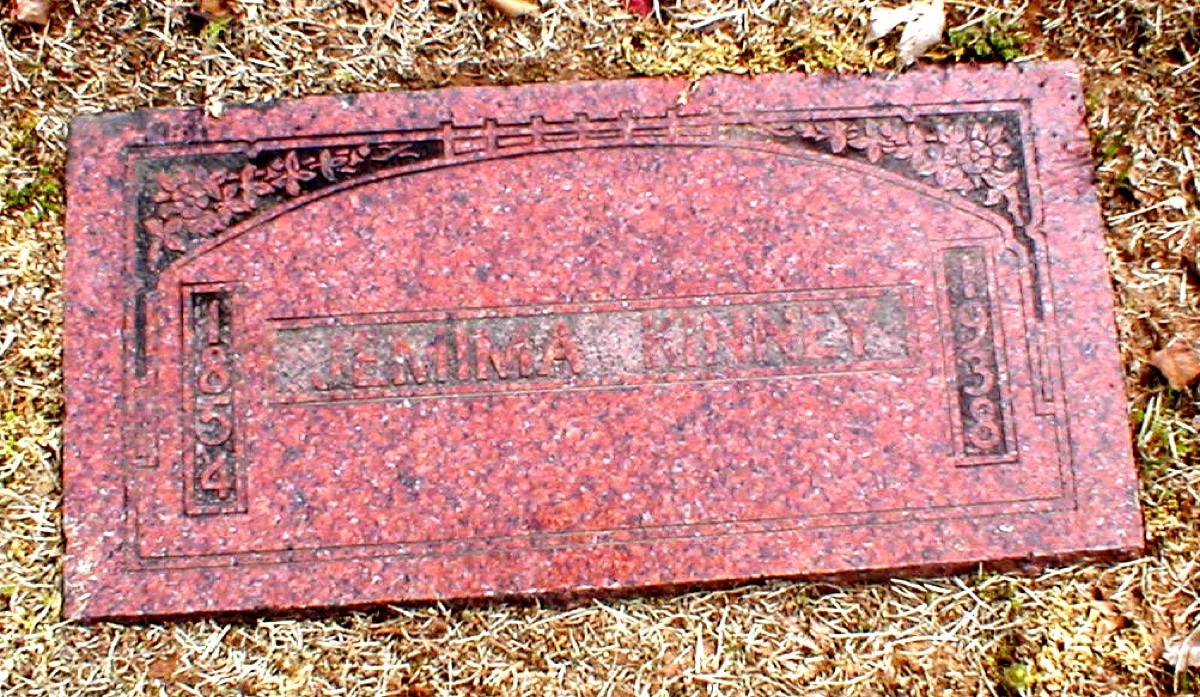
Charles died in Edmond 7 November 1930,[98] 9 days before his 66th birthday.[99] At some point, Jemima moved back to Owasso and died there eight years later, 13 October 1938, aged 84. They are buried in Memorial Park Cemetery in Oklahoma City, near Edmond.[100]
Charles’ obituary read as follows: [101] [102]
C. O. Kinney, Edmond Business Man Dies. Charles O. Kinney, one of Edmond’s highly respected grocers, passed away Friday night, November 7 at his home, following a heart attack. Mr. Kinney’s passing leaves to mourn his loss countless friends, besides his family. Funeral services were conducted by the Pass Funeral directors Monday, at 3 p. m., at the Presbyterian church with Rev. C. W. Spier officiating. Burial was at Memorial Park cemetery. Mr. and Mrs. N. D. Smith and their son and his wife, DeWitt Smith, of Tulsa; Mrs. A. T. Kinney, Hutchinson, Kans.; J .R. Kinney, Denver, Colo.; and Ernest Bryant and wife of Owasso, Okla. attended the funeral of Mr. C. O. Kinney.
Jemima’s obituary in the Edmond newspaper read as follows:
OBITUARY. Mrs. O. C. Kinney—Jemima Gilmore was born near Bowling Green, Mo. on the 28th day of March in 1854. She passed away October 13, 1938 at the age of 84 years, six months and 15 days. She was united in marriage 11 April 1876 to J. Richard Martin. To this union two children, Lucy Ann and Bettie B. were born. While these children were babes, Mr. Martin passed away.[103] In 1891 on the 28th day of May[104] she was married to Charles Kinney. He also preceded her in death passing away on November 7, 1930. Mr. and Mrs. Kinney moved to Oklahoma in 1901. In 1921 they made their home in Edmond. Mrs. Kinney had reared several orphan children. She was a member of the Presbyterian church of Edmond. Mrs. Kinney leaves to mourn her passing, two daughters, Mrs. N. D. Smith and Miss Bettie Martin, a grandson, DeWitt Smith, a sister, Mrs. Marion Lowery and several nieces and nephews.[105] Mrs. C. O. Kinney Passes Away—(1:00 am, Oct. 13, 1938 handwritten on clipping.) Mrs. C. O. Kinney, age 84, passed away Thursday morning at the home of her daughter, Mrs. N. D. Smith, at Owasso, Oklahoma, following a two month’s illness. Mrs. Kinney is a former Edmond resident, and she and the late Mr. Kinney operated a grocery here for several years. Funeral services will be at the Presbyterian Church at 2 p.m., with Rev. C. W. Spier officiating. Burial will be in Memorial Park Cemetery, with Paas Funeral Directors in charge. [Oct. 14 handwritten on clipping.] Survivors are two daughters, Mrs. Smith and Miss Betty Martin, also of Owasso; a stepson, Joe Kinney of Denver Colorado; one sister, Mrs. Lowery of West Tulsa; a grandson, Mr. DeWitt Smith, his wife and daughter.[106]
Obviously, after her husband’s death, Jemima moved back to Owasso to live with Lucy. However, she and her husband Charles are buried in Memorial Park Cemetery, near Edmond, Oklahoma City, Oklahoma.
Dick and Jemima’s Daughter Bettie Bowen Martin
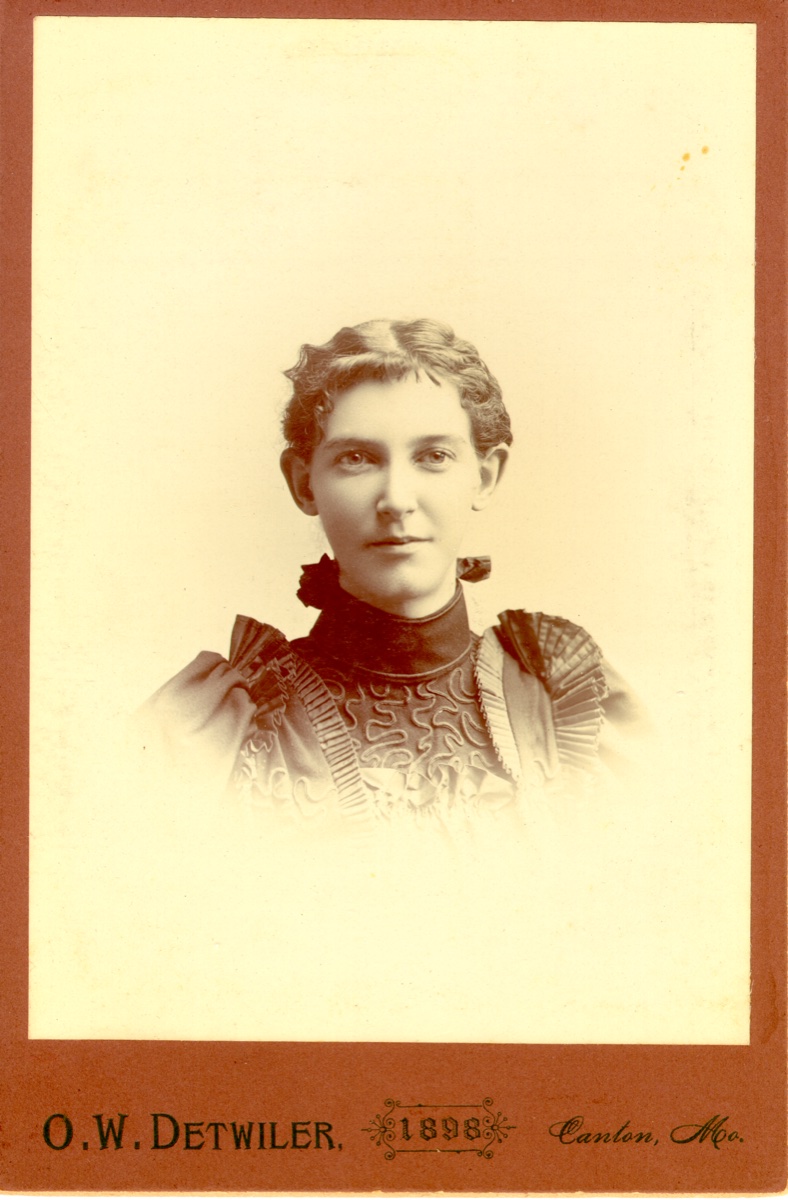
Bettie Bowen Martin, named after her father’s twin sister, was born 7 April 1879 near Vandalia, Audrain County, Missouri, 15 miles west of Bowling Green, in Pike County.[107] [108] It appears that Bettie never married, and was said to not trust men. According to her sister’s granddaughter’s husband, “She never even dated.”[109] Perhaps she moved to Edmond with her mother and stepfather, but at some point she returned to Owasso and lived with her sister. She worked some years as a school teacher in and around Owasso and also taught at the Pryor, Oklahoma orphanage, about 30 miles east of Owasso. She graduated from State Teachers College in Edmond, Oklahoma.
In a 1965 newspaper article about a new display of Owasso’s history at the library, the writer noted:[110]
Among the old-timers enjoying the day were Nat Smith, Owasso’s first teacher and one of the first school board members and his sister-in- law, Miss Betty Martin, also an early teacher.
The next year, Batty and Nate again participated in the history display at Owasso library. Betty and Nate had their picture in the paper. [111] It was titled: “Dean Buckles, Owasso Merchant for 43 years, Miss Betty Martin, second teacher in Owasso and N. P. Smith, first teacher in Owasso, discuss old times at the library where everybody met to see the historical displays and visit.” Scan and insert photo of Betty and Nate from Reporter, 22 Sept 1966.
Need sketch of Bettie here. She was a school teacher. What did she teach? Ask Albert #.
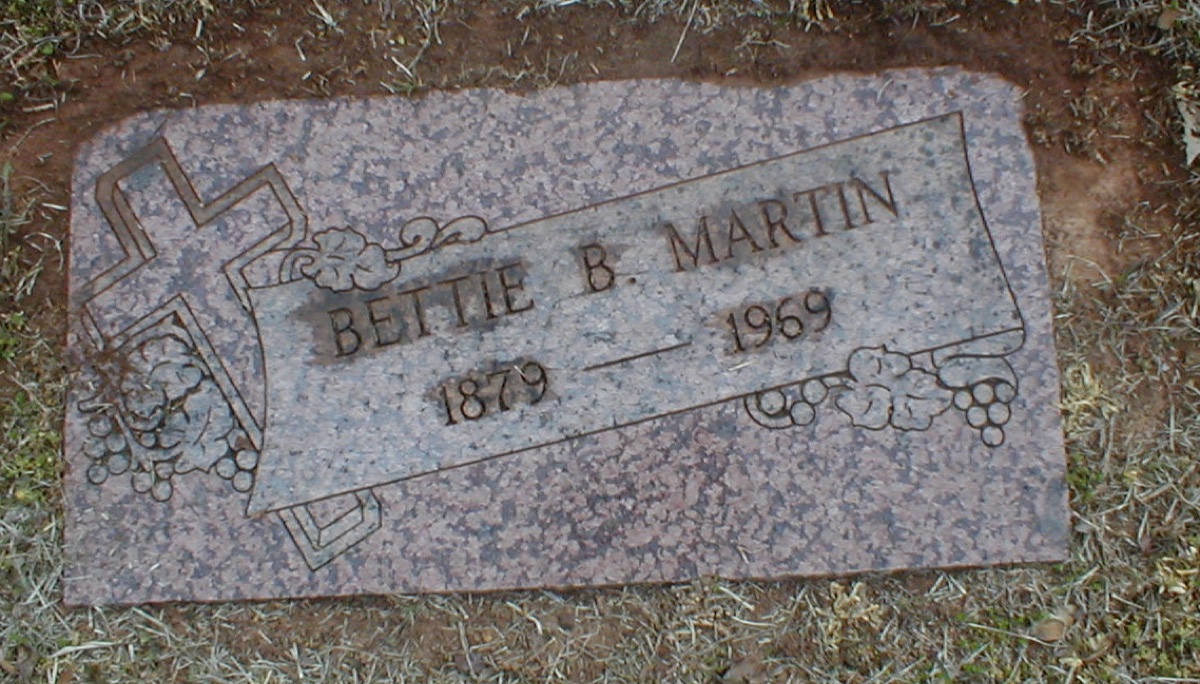
She died at age 89, 23 March 1969 in the Nowata, Oklahoma General Hospital, about 35 miles north of her home in Owasso. She is buried 100 miles from her home, in Memorial Park Cemetery in Oklahoma City, Oklahoma, next to her mother and step-father.[112] [113] [114]
Bettie’s obituary in the Nowata paper read: [115]
Miss Martin Dies at 89. Services are pending for Miss Betty Martin, 89, of Owasso, who died Sunday in Nowata General Hospital. Miss Martin was born in Vandalia, Mo., April 7, 1879, and moved to Owasso in 1901. She was a school teacher in and around Owasso and for the past eight years she had taught at Pryor Orphanage. Her father was mayor of Owasso at one time and had a department store. Survivors include a nephew, DeWitt Smith of Greenfield, Iowa.
The Owasso paper reported: [116]
Pioneer Teacher Dies in Nowata. Bettie B. Martin, 89 died March 23 in Nowata, Okla. Miss Martin came to Owasso in 1901 and was a school teacher in and around Owasso. The last eight years of her teaching career, however, were in the Pryor Orphanage. For years she had made her home with her sister Lucy Ann Smith, who preceded her in death in 1966. Survivors include: DeWitt Smith, nephew and wife of Owasso; a cousin, Marguerite Paulson, Yakima Wash.; a brother-in-law, Mr. N. D. Smith of Owasso.
The cousin, Marguerite Paulson of Yakima, Washington, mentioned in Bettie’s obituary was the daughter of Jemima’s sister, Marion Lowery, “Aunt Madge.”[117]
Dick and Jemima’s Daughter Lucy Ann Martin
Named after her mother’s mother, Lucy was born 31 March, 1877[118] [119] in Bowling Green, Missouri. At age 24, she and Bettie moved with her parents to Owasso in 1901. Both went to work at a new school established largely for Indian students. There Lucy met the principal, Nat Smith. Lucy married Nathaniel “Nat” DeWitt Smith of Owasso, both 26, in her home in Owasso, 5 April, 1903.[120] [121]
Nat was born in Maysville, Arkansas 4 February 1877.[122] He was the son of John Jackson Smith and Sarah Penelope Fields.[123] His parents are buried in Fairview Cemetery in Owasso. He was also a citizen of one of the Five Civilized Tribes, The Cherokee Nation. On 17 July 1906, he received a deed for thirty acres as provided by an Act of Congress.[124]
Lucy and Nathaniel had two children, Nathaniel DeWitt Smith, Jr. and Charles Joseph Smith. Charles died as an infant and is buried in Owasso, next to his parents. Charles’ obituary read: [125]
DEATH OF LITTLE BLUE EYED BOY. The infant son of Mr. and Mrs. Nat D. Smith of Owasso, I. T., born December 31, 1906, died Jun 12, 1907 after a week’s illness of cholera infantum. Little Charles was a bright blue-eyed boy of unusual promise and during his five and one- half months’ life had attracted a host of friends, beside his family and relatives, who gathered at his funeral to extend their sympathy to his bereaved parents. The funeral services were conducted on Jun 13 by S. W. Marr of Tulsa. Four little girls assisted singing “When He Cometh” and also acted as pall bearers. He was buried in Owasso cemetery under a bank of roses to await the trumpet’s sound and his Savior’s welcome, who said: Suffer little children to come unto Me, and forbid them not, for of such is the kingdom of Heaven.” To the bereaved parents we would say: “Grieve not with hopeless sorrow, Jesus has felt you pain; He did thy lamb but borrow, He’ll give him back again.” A. Friend.
Nat and Lucy Were Teachers
Nat, Lucy and Bettie were all teachers in Owasso. [126]
Education in Owasso has seen many changes since 1885 when George Gassoway became a teacher in Indian Territory. He would not have been allowed to teach had he not married an Indian or part Indian. He did marry Mary Holland, this made him eligible to teach. Lulu Barnes in 1898 established a subscription school of about 20 students located in the vicinity of the present Odd Fellows Hall. In 1903 a frame building was built to accommodate the school needs in the Indian Territory ere. Nat. D. Smith was the first teacher. He enrolled forty-seven children at one dollar per pupil per month. Beginning the second term C.O. Kinney’s step daughters, Lucy Ann and Bettie B. Martin began teaching at the school. This structure was also used as a meeting place for City government. Later the School Board sold the building to the Odd Fellow Lodge of Oklahoma in 1910.
The Smallpox Affair
After only a few years teaching in Owasso, Lucy became involved in a controversy. She was accused of bringing small pox to her school. The newspaper reported the affair extensively. [Source citation?]#
School Smallpox Scandal Causes Owasso Town Fight, The Owasso Oklahoma April 30, 1985(?#) By H. H. Mills Student walkouts, lawsuits, contagious diseases, and complaints from parents are routine matters for school boards today – but they are nothing new. Controversy “over a teacher who is accused of spreading smallpox” caused a “town fight” in Owasso in 1908.This turbulent era in the Owasso school system is captured in strong wording in the March 12, 1908 edition of the Oklahoma World, published in Tulsa. Aliene Anderson---whose mother was one of the “fifteen women of Owasso” who led the fight against the accused teacher, Mrs. Nat. D. Smith — retains the newspaper clipping among her family keepsakes. An unidentified reporter – whose indignance after being thrown out of a hearing by the county attorney may have affected his journalistic objectivity—relates the story. “Fifteen women of Owasso, fifteen of the best women of the town, so it is declared, swooped down upon the county officials yesterday, and demanded their rights and the rights of their children. They came to Tulsa and stayed all the afternoon, pleading with the officials to take some action in the school controversy now causing worry to the citizens of the town. They came to lay the facts, as they see them, before County Attorney Breckenridge and County Superintendent Grimes, and to appeal to them to lead the law’s assistance to ending the struggle that has town that town apart. Both officials refused yesterday to give the matter any further consideration and what the disagreement may lead to now is a question. “anger in their hearts…..” The committee of fifteen went home last evening with anger in their hearts and declare that in spite of the manner in which they were treated by the officials they have rights which must and will be recognized. The trouble reached an acute condition Monday evening. County Treasurer Richardson and William Smith, members of the old Indian Territory (school) board appeared at nine o’clock, and after delivering short addresses, delivered the school over to the new directors, the membership of which is composed of John Ingram, Nat (D.) Smith and Boone Gray. No sooner had they finished their addresses than a large number of the children, under instructions from their parents, got up and marched out of school. The parents of the children who left the building declare that as long as Mrs. Nat (D) Smith is a teacher in the school, they will not send their children there. They allege that Mrs. Smith brought smallpox to the school, exposing the entire school to the disease, with the result that the contagions swept over the little city and caused almost a complete isolation from the outside world for some time; seventy cases, they claim, are traceable to the school, Mrs. Smith, it is said caught the disease at the Palace hotel, which is managed by her parents, Mr. and Mrs. Kinney. “the complaint was quashed…..” Several weeks ago, on February 3, complaint was filed in the county court against Mrs. Smith for exposing herself while infected with the small pox in a public place. The complaint was quashed upon the recommendation of County Attorney Breckenridge, who declared that the party making the complaint had no interest by reason of not having been damaged by the circumstances alleged. The county superintendent was appealed to about the same time the information was filed against Mrs. Smith. He sent out a young man to take charge of the school. The people who were desirous of a change though they had matters all fixed to make a contract with the young man to become the successor of Mrs. Smith. He taught but three days, however, as the directors stepped in and locked him out, saying that until Mrs. Smith could teach, the school would remain closed. Mrs. Smith is the wife of one of the directors and another on the board is favorable to her. The third member is said to be in favor of releasing Mrs. Smith from the position, but can do nothing with the odds against him. “the better element of the town….” The people who came to this city yesterday to consult the officials claim to represent the better element of the town and say that it is to the best interests of the schools that Mrs. Smith be removed. The people who wish Mrs. Smith removed came to Tulsa yesterday afternoon determined to file information against Mrs. Smith and to ask Superintendent Grimes to remove her. In the party were Mrs. R.C. Mitchell, Mrs. Roy Archer, Mrs. Houston, Mrs. S. T. Wolfe, Mrs. Edward Macey, Mrs. J. T. Barnes, Mrs. Johnson, Mrs. Pius, Mrs. T.T. Anderson, Mrs. A. Carlin, Mrs. A.C. Bateman and Mrs. George Thompson. It being in the nature of a public hearing, a World representative went to Mr. Breckenridge’s office to hear the petition of the women. When Mr. Breckenridge appeared he scanned the assemblage and finally his gaze rested on the World man.“You’ll have to get out of here,” he said, and he motioned to the door. “In the nature of the public hearing, isn’t it?” asked the World man. “We are willing to have what we say made public,” broke in one of the delegation. “I can’t help it; this man will have to get out,” and the World man withdrew. Breckenridge listed to their petition briefly. “I’ve got business in the jury room,” he said, and despite protestations, he left these women who had come twenty miles to see him. The women say he refused information for an indictment against Mrs. Smith, although Mrs. T.T. Anderson, declaring that she had been damaged and was interested, offered to take oath. He refused to listen to any petition and abruptly left them. (Mrs. Anderson, who later became the mother of Aliene Anderson, had sons in the Owasso school at the time of the small pox epidemic. Her husband, T.T.Anderson, caught the disease and nearly died of it.) County Superintendent Grimes took matters in a different light, but only slightly. He listed to their petitions, but he declared that he could do nothing for them. “….further trouble is expected….” Now that the county officers have refused to take action, further trouble is expected. The whole town is up in arms, every person is either on one side or the other. A portion of the residents have taken Mrs. Smiths side. They declare that she caught the smallpox in the school and she suffered along with the others. They declare that she is an excellent teacher; that she is of high moral character; in short, nothing can be said against her. That the bitter fight will be carried to the limit, both sides declare. Action on the part of the county officials might have presented it. Their refusal to take action will be regretted later. “…her husband sprang in the attack…” The Kinneys, parents of Mrs. Smith, have achieved considerable notoriety during the time this school fight has been raging. In a ????? in which they are interested, having been filed in the county court by appeal from the Owasso mayor.. They were arrested on a charge of interfering with a refusing the attempts of the health officer and ????? to examine the inmates of the hotel for the purpose of finding out whether or not small pox was present at the place. Mrs. Kinney refused to recognize the authority of the officers and was put under arrest. She laid down readily , refusing to go along , and it is said that her husband sprang in the attack with a chair. The Kinneys were then made to re-enter the hotel and the building was placed under quarantine. Ten days later, before the mayor, the hotelkeepers were fined $50 each…….” [127]
[Need sketch of Lucy’s life and Charles. Bettie was a school teacher: Albert Scott suggests: Contact Ester Cornish, Clarkswell, knew Nina’s sister. ]
Note teaching certificate given Lucy, 24 July 1924. Recognizes earning credits at State Teachers College in Edmond Ok.]
In 1928, Lucy and her husband Nat are living in Elmer, Oklahoma, about 220 miles Southwest of Owasso. We don’t know why they are teaching there. Her son DeWitt is attending State Teachers College in Edmond, Oklahoma. Her devotion to him is strong. DeWitt will turn 24 in February. In 1928, when she was fifty-years-old, and her son DeWitt was 24, Lucy wrote this rather depressing letter to her mother Jemima in Edmond.
Route 1, Elmer Okla, Jan. 21, 1928 Dear Mother, Flora and all; I received the card Friday, containing the report on DeWitt’s illness. Of course I was upset the balance of the day. Please don’t keep anything from me. I don’t care anything for this old school, but my whole future (earthly) is centered in DeWitt. You know that that is the reason that I have continued teaching so long, even when I was not able, in order that he could have advantages that otherwise would have been denied; so that when he got in a pinch and needed money and Dad refused that I could be independent, could write the check and not have to beg or plead his cause to his Daddy. I know that in many cases it would have been better for him to have made him root pig or die, but I just couldn’t stand to see him want or wish for anything that I couldn’t supply. Now please watch closely and notify me promptly. There is a telephone in the teacherage. So call number B25 Elmer at the Hess Teacherage.[128] The phone is on a party line out of Elmers, therefore you have to call Elmer as the Central office is there. I just have one more week left on the first term of four months, so next week will be taken up with term examinations, grading papers, posting registers, and grade cards. I wish I could come home then, as I am getting so tired of filling so ungrateful a place, then also I never have a penny left. I can’t see where my profit is in sacrificing life when, I neither gain money, pleasure, nor praise; when I am even shutting out the heavenly light by filling up all my hours, night and day, with complete drudgery. My only gain has been in being able to help others and then have them tell me that I never do anything, so unless God sees things differently, I am a complete failure. I had just sent DeWitt a letter a day or two before I got the card. The letter had a check in it. I guess he has received it by now. I would have sent the letter sooner but could get no stamps. I will have to quit writing. I stopped eating my breakfast to write this letter so Nat could take it to Altus and mail it. The mail-man has past us at Hess and as Nat is going to Altus to get his laundry I am trying to finish this in time for him to take. Doubt if you can read it. After I finish this I will have to wash and dry dishes, scrub the sooty floor and wash out a few clothes for myself. Whish you could see this floor. Nat cleaned out the flue that was so completely filled up with soot that it smoked us out. I think you can fully understand, because you know when Nat cleans, he also musses. So therefore he got the floor full of soot and tracked mud in on top of it. Do you get the picture? Tell DeWitt that Daddy has written a letter to the Okla. Natural Gas Co. authorizing them to send meter readings and check for gas to 710 E. Main, DeWitt Smith. So be looking for the same and file away your meter readings. Now Dad didn’t say to file them away, but I thought it might be best to do so in case they were needed for future reference. Tell Flora that I will try to find time to write to here later, but with daily duties, and night school and home duties I am about snowed under. Hug and kiss my boy two dozen times for me and tell him if he wants Mamma that I’ll surely come on the next train. Write often. Lovingly your Inferior Runt, Lucy Ann.[129]
Deaths of Nat and Lucy
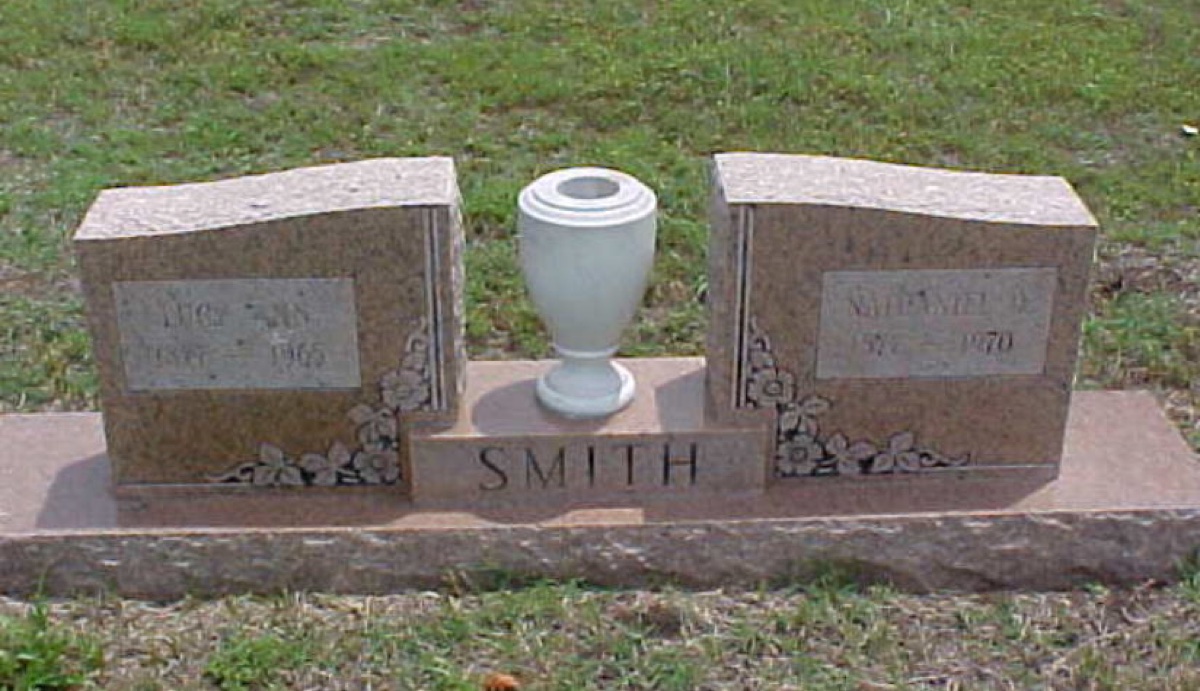
At the age of 88, Lucy Ann Martin Smith died 23 June 1965 in Owasso.[130] Funeral services were held at The First Baptist Church.[131] No record of an obituary has been found. She is buried beside her husband in Fairview Cemetery, Owasso, Oklahoma.[132]
Six years later, having just turned 93, Lucy’s husband Nat died in Owasso, Oklahoma, 13 February 1970.[133] [134]
His informative obituary was published in The Tulsa Tribune.[135]
Ex-Owasso Pioneer Dies Of Seizure. Special to the Tribune. OWASSO —Nathaniel DeWitt Smith, 93, pioneer Northeast Oklahoma teacher and early-day Owasso druggist, ferryboat operator and farmer, died of an apparent heart attack Friday in a physician’s office here. Mr. Smith was stricken while convalescing from abdominal surgery for cancer undergone last October. He had lived in the Owasso area for more than 70 years after teaching earlier in a rural school near Vinita. His first work here was as a surveyor, helping lay the tracks for the Santa Fe Railroad into Oklahoma as far as Owasso. Mr. Smith later was a part-owner of a drug store here and operated a ferryboat over Bird Creek south of Owasso. HE RETURNED to teaching in the 1920s and early 1930s, serving about eight years at Mingo School, northeast of Tulsa, where he was credited as being instrumental in the construction of the present brick classroom building. After retiring from teaching, he farmed in this section until retiring. In the 1950s, his farm 1½ miles east of Owasso was one of the first in Tulsa County to be placed in the federal Agricultural Department’s Soil Bank. Mr. Smith was born in Maysville, Ark., and had received bachelor’s degrees from the early-day Cherokee Male Seminary in Tahlequah and Central State College in Edmond. He was a member of the Baptist Church. Surviving are a son, DeWitt of Owasso, and a grandchild. Services will be held at 2 p.m. Monday in the First Baptist Church here. Burial will be in the Owasso Cemetery under the direction of the Fitzgerald Funeral Service, Tulsa.
Lucy and Nathaniel’s son, N. Dewitt Smith, Jr.
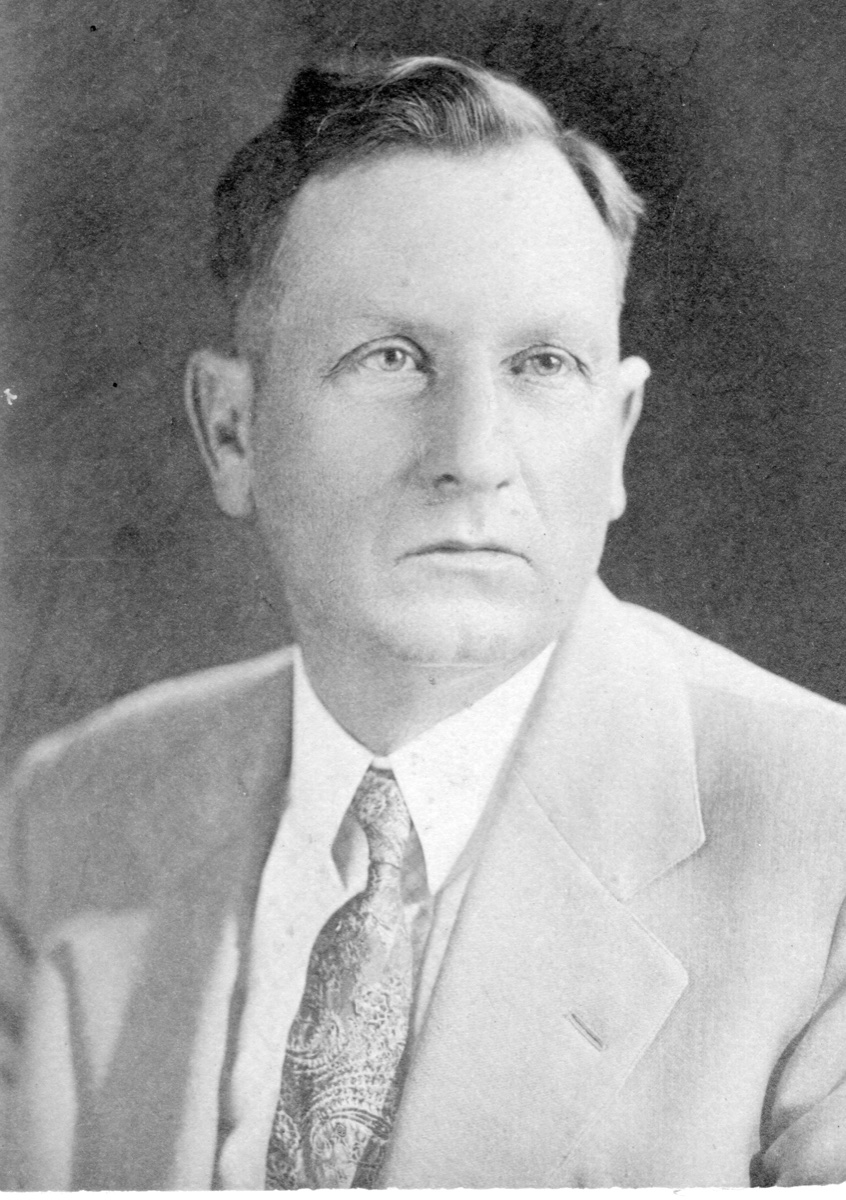
Nathaniel DeWitt Smith, Jr. was born in Owasso, Oklahoma on 22 February 1904. DeWitt married Nina Ellen Cornish 17 July 1930 in Bartlesville, Oklahoma. She was the daughter of Charles J. Cornish and Aseneth E. French. Nina was born 16 June 1911 in Oblong, Illinois.
DeWitt told his friend Wildeana Smith that “their home was quiet, no visitors so he was quite lonely and didn’t have friends. Now he wonders if it was because of his mother’s sharp tounge. His grandmother was more social.[136]
For 25 years after leaving Owasso, DeWitt Smith lived in Gentry, Benton County, Arkansas. At age 99, 4 March, 2003, DeWitt Smith died in nearby Siloam Springs in a nursing home. A year before he died, DeWitt’s friend Wildeana Smith, of Gentry, described him thus: [137]
DeWitt is a very intelligent man. After retirement he taught himself Greek and Hebrew so he could research Bible issues and has written several books. He is accomplished on the piano and has his in his room where he still plays beautiful and “hard” classical music. His mind is good enough to still play the stock market. His grandmother told him how very brilliant his grandfather Martin was. If schools had trouble with any math it was brought to him. I guess he drank on weekends which caused the divorce, but she must have been proud of him to share this with DeWitt as a teenager. DeWitt has always told me his mother Lucy was very smart. So is DeWitt.
DeWitt’s wife Nina died 5 August 2000 in Siloam Springs, Arkansas. She is buried in the Fairview Cemetery, Owasso, Tulsa County, Oklahoma in the Smith family plot.
Nina’s obituary read:[138] [check obit sources.]
Nina Ellen Smith. Nina Ellen Smith, 89, a resident of Siloam Springs, Ark., died Saturday, Aug. 5, 2000, at Siloam Springs Memorial Hospital. Born June 16, 1911, in Oblong, Illinois, she was the daughter of Charles J. Cornish and Aseneth E. French Cornish. Formerly a resident of Owasso, Okla., Smith had lived in the Gentry and Siloam Springs area since 1972. She was a homemaker and a member of the Seventh Day Adventist Church in Gentry. She was preceded in death by one daughter, Nadine Loretta Scott. Survivors include her husband of 70 years, DeWitt of the home; one son-in-law and his wife, Albert and Lois Scott of Wesley, Ark. SILOAM SPRINGS - Nina Ellen Smith, 89, of Siloam Springs died Aug. 5, 2000, at Siloam Springs Memorial Hospital. She was born June 16, 1911, in Oblong, Ill., to Charles J. and Aseneth E. French Cornish. She was a former resident of Gentry and Owasso, Okla. She was a homemaker and a member of the Seventh-day Adventist Church in Gentry. Survivors include her husband, Dewitt Smith of the home, to whom she was married 70 years; one son- in-law, Albert Scott and wife Lois of Wesley; one granddaughter, Dana Little of Wesley; one great-grand- daughter, Hannah Murphy of Wesley. Services will be at 10 a.m. Thursday at Wasson Funeral Home in Siloam Springs with Tim Roosenberg officiating. Graveside services will be at 3 p.m. Thursday at Fairview Cemetery in Owasso.[139]
DeWitt died 3 years later at age 99. He had prepared his own obituary: [140]
Nathaniel DeWitt Smith. N. DeWitt Smith, 99, of Siloam Springs, Arkansas, died March 4, 2003, at Siloam Springs Nursing and Rehab, Siloam Springs, Arkansas. He was born February 22, 1904 in what used to be called Indian Territory at Owasso, Oklahoma to Nathaniel D. Smith and Lucy Ann Martin Smith. He came from a family of teachers. He was the grandson of John Richard Martin and Jemina “Pinkie” Gilmore. His grandfather was for 45 years, a teacher in Fulton, Missouri, and also a noted Confederate soldier – a member of Fauquier County, Virginia’s famous Black Horse Cavalry. Dick Martin carried the dispatch from Stonewall Jackson to General Robert E. Lee notifying him of his victory at Harper’s Ferry and Lee sent him back to Jackson urging him to effect a junction at Sharpsburg. Dick’s brother, Robert Edward Martin, received a rifle as the “bravest man in Lee’s army” His grandfather’s adventures and those of his entire family during the war were described in Women of the Debatable land and Johnny Reb and Billy Yank, both by Black Horse Cavalryman Alexander Hunter. Smith grew up in Owasso and attended high school there in his Freshman and Sophomore years, but finished his high school education at Ramona,[141] Oklahoma in 1922. He attained his TH.B degree at Emmanuel Missionary College in Michigan and his B.A. degree at the State Teachers College in Edmond, Oklahoma. He took graduate courses in instrumental music at the Oklahoma State University in Norman, Oklahoma and at the Michigan State University at Ann Arbor. His first public school teaching was at Delaware, Oklahoma where he served as principal of the grade school in 1930 and in that year married Nina Ellen Cornish on June 17th at Bartlesville, Oklahoma. One daughter, Nadine Smith (Scott) died in 1973 at the early age of 36. His wife died August 5, 2000. Mr. Smith started out life serving one summer as Assistant Pastor of the Mobile Adventist Church in Alabama, but soon found out that his talents lay in the direction of teaching rather than preaching. Altogether he taught 40 years. Five of these years were in Adventist schools. One at Binger, Oklahoma, one at Tulsa, Oklahoma, one at the South Side school at Chicago, Illinois, one at the Golden Gate Academy at Berkeley, California and one at the Sunnydale Academy at Centralia, Missouri. The remaining 35 years were in the following public high schools: 10 years in Oklahoma at Delaware and Homing, 5 years in Illinois at New Canton and Ohio, 1 year in Nebraska at Sargent, 19 years in Iowa at Richland and Orient. Funeral service will be 10:00AM, Monday March 10, at Wasson Memorial Chapel, Siloam Springs, Arkansas, with Pastor Jim Taylor officiating. Burial will follow at Fairview Cemetery, Owasso, Oklahoma. Visitation will be 4:00 to 6:00 p.m., Sunday at Wasson Funeral Home. Arrangements are under the direction of Wasson Funeral Home, Siloam Springs, Arkansas.
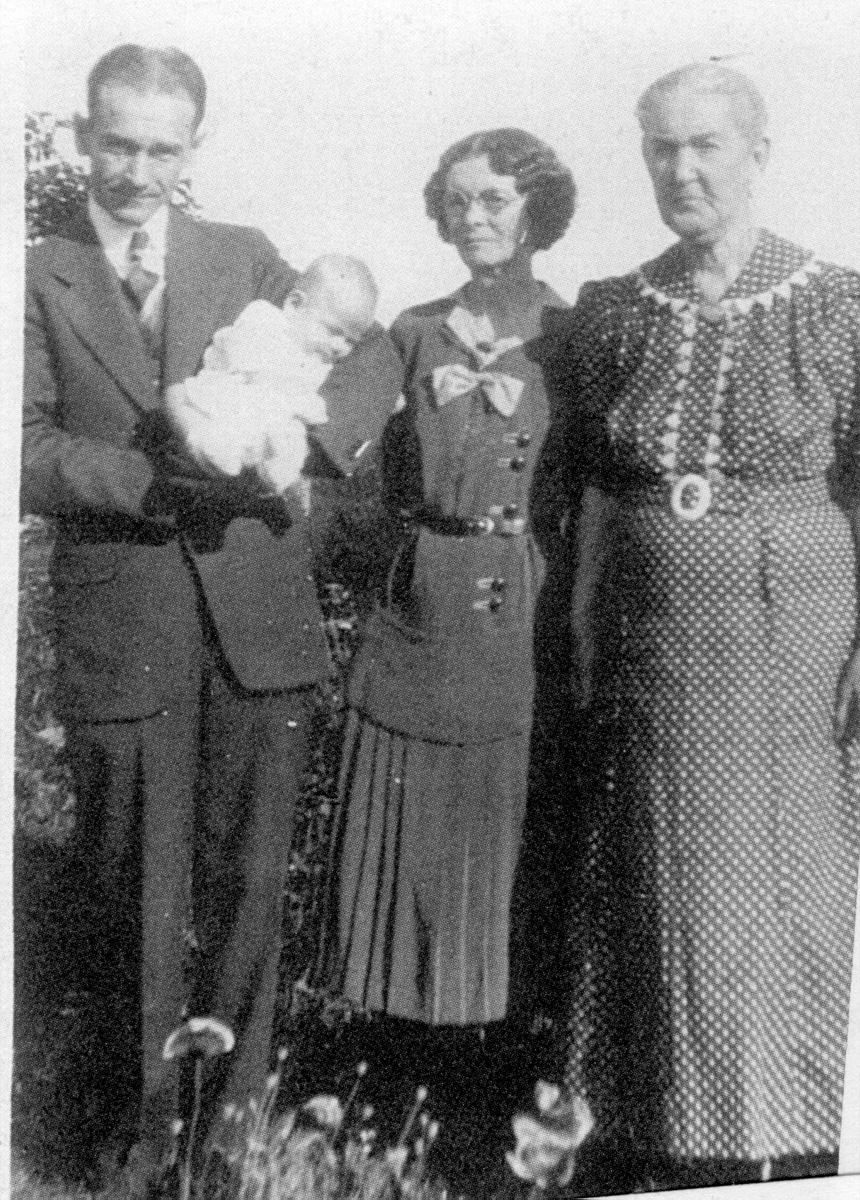
DeWitt’s Daughter Nadine
DeWitt and Nina had one child, a daughter, Nadine Loretta Smith, who was born 5 February 1938 in Hominy, Oklahoma where her father was teaching. She attended Union College in Lincoln, Nebraska, earning a teaching certificate. Nadine taught school in a private church school in Iola, Kansas, about 110 miles N. E. of her home in Owasso, Oklahoma.[142]
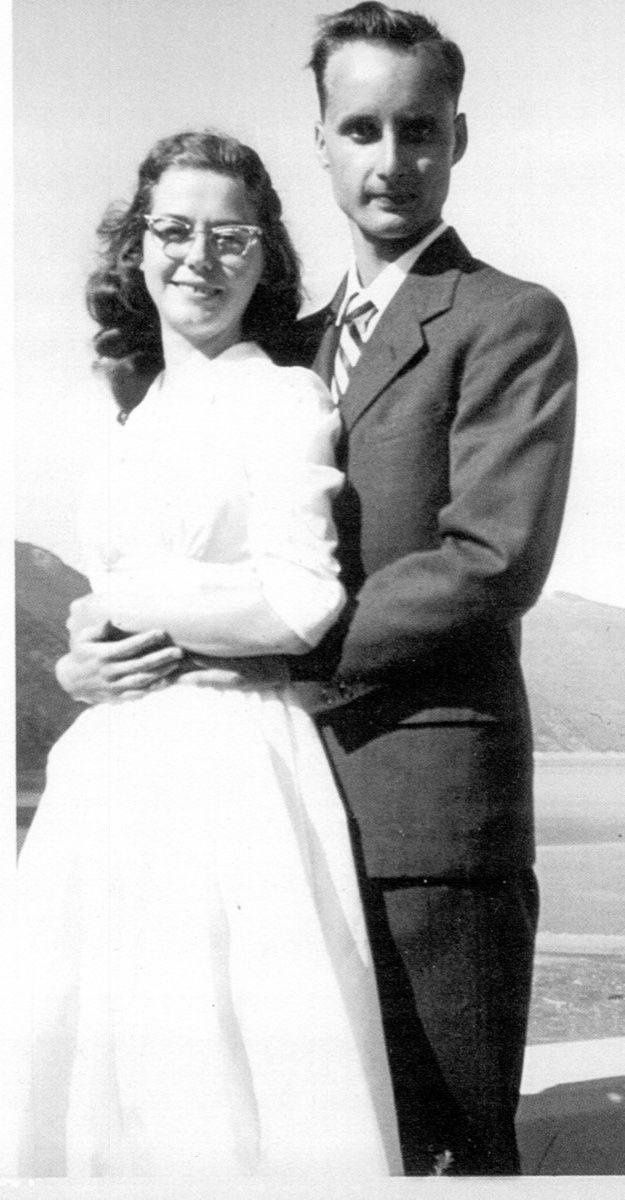
Nadine married Albert Allie Scott, 9 October 1960 in Stanwood, Washington. Their marriage was announced in the newspaper: [143]
Nadine Smith Wed in Washington. Mr. and Mrs. DeWitt Smith of Greenfield [Iowa] are announcing the marriage of their daughter Nadine to Albert A. Scott of Ronald, Washington, which took place on Sunday, October 9 [1960]. The simple ceremony was solemnized in the home of the minister, Pastor C. A. Andersen of East Stanwood, Washington. Mr. Scott is employed by the Walsh Saw Mill Company near Ronald. The couple will build a home and reside in a rural district near Ronald.
Albert was born 10 February 1935, in Granger, Washington and was the son of Willis Mark Scott and Florence Gertrude Boss. In 2006, he lives in Wesley, Arkansas. He and Nadine had no children. At age 37, Nadine died 29 August 1975 in Wesley. She is buried in Bohannon Mountain Cemetery in Wesley. [144]
[Need a little longer sketch about Nadine’s life.
What Happened to Dick’s Relationship to his First Two Daughters?
According to DeWitt Smith, there was a complete estrangement between Dick and his first family. DeWitt’s mother, Lucy, never saw her father again after she moved to Oklahoma. She knew about her half-sister Mamie, but never met her. DeWitt said that Dick was not then a Christian and drank heavily. Dick’s granddaughter Aileen said that her mother never mentioned her half-sisters by her father.
This estrangement is supported by other evidence. In her 1919 will, Dick’s sister Mildred, back in Virginia, only recognized one niece, Mamie, Dick’s daughter by Mary Gregory. There was no mention of Lucy or Bettie. In his daughter Mamie’s obituary, it was noted that two sisters (according to Mamie’s daughter Aileen, from her mother’s earlier marriages) had predeceased her thus Mamie certainly knew those half-sisters, but did not mention her other two half-sisters, Bettie and Lucy. Bettie’s obituary also mentions that her “father” had a department store. This reference was to her stepfather, Charles Kinney, not her father Dick. Yet, Bettie certainly knew who her father was as he was clearly named in her funeral home record. She and her sister were 12 and 13 when their mother remarried.
And finally, in one of Jemima’s obituaries, it was stated that Dick had died while the girls were “babes”. However, they were both in their mid- thirties when their father died. Jemima must have wanted to erase her connection to Dick, and seems to have succeeded.
Dick’s Marriage to Mary Gregory
Dick Martin married his second wife, Mary A. Gregory about 1888 or 1889. [Need date and place of marriage.] She was born 1 April 1860 in Wright City, Warren County, Missouri, and was the daughter of John B. Gregory.[145] [146] Dick was about 19 years her senior, but he outlived her. Dick was now about 48 and Mary about 29. Mary had lived in a foster home.[147] [148] They had one child, a daughter, Mamie. Mary had been married twice before.
Mary’s First Marriage to John Doring
First, she married John B. Doring,[149] probably in Lincoln County, Missouri. Mary must have been very young when she married Doring, as she married her second husband when she was 20. John is buried [Need tombstone info. Barb will send] in Wright City, Missouri. They had a daughter Annie. Annie married Julian Thomas, who sold stained glass church windows, and lived in St. Louis. He was a salesman for Kokomo Art Glass Co., Kokomo, Indiana. Annie and Julian had two children, Marvin, and Alice Virginia. Virginia married a Cowling. Marvin served in the military in the Philippines.[150]
Mary’s Second Marriage to Samuel Groshong
Mary may have married Samuel Jeremiah Groshong, 11 January 1880 in Lincoln County, Missouri. He was forty-four and she was twenty. Samuel was born 2 August 1836 in Missouri and died 19 May 1917 in Monroe, Lincoln County, Missouri. He is buried in Highland Prairie, Lincoln County, Missouri. He was the son of Jacob De Clement Groshong and Eliza Jane Nichols.[151] [152] They must have divorced since Mary was married to Dick Martin by 1889.
They had a daughter, Callie B. Groshong, nicknamed “Tad”, born in November, 1880.[153] Callie married Bruce Stickley and they lived in Jacksonville, Morgan County, Illinois. Aileen Wright said that is how her mother wound up in Jacksonville—she moved there to live with her sister Callie. Bruce was a traveling man. They had a son Kenneth, who died in fire in Detroit, Michigan sometime in the 1950s.[154]
Death of Mary Gregory Martin
Living in Audrain County in May 1898, Dick and Mary executed two deeds, selling some of the land he inherited from his father to his sister and giving some to his nephew Ernest Lee Childs.[155] A little later, in 1898, Dick and Mary sold land he inherited from his brother Josh.[156]
Living with Dick, Mary Gregory Martin was listed in the 1900 census as the mother of four children, of whom three were living. Two daughters lived with her, Mamie and Callie who was a dressmaker. They had been married 11 years[157] Annie had probably married and left home.
Mary A. Gregory Martin died of tuberculosis, 24 January 1913; age fifty- two, in Fulton.[158] [159] She is buried in nearby Wright City, Warren County, Missouri. Her grave is next to her first husband’s.[160] [161] When filling out her death certificate, her daughter Mamie knew Mary’s father, but did not know the name of Mary’s mother or Mary’s birthplace.
Mary’s obituary read: [162]
Mrs. J. R. Martin Dead. Wife of Veteran School Teacher of Callaway County Dies of Tuberculosis. Mrs. Mary E. Martin, wife of Prof. J. R. Martin, the oldest school teacher in the Kingdom of Callaway died at her home on Bluff street in this city at 5 o’clock Saturday afternoon. The funeral services were held at the residence, conducted by Rev. T. E. Winter of the First Christian Church, at 2:30 o’clock Sunday afternoon. The remains were shipped to Wright City, Mo., for burial. Mrs. Martin was 52 years old. She leaves three daughters, Mrs. Bruce Stickley of Jacksonville, Illinois, Mrs. Julian Thomas of St. Louis and Miss Mayme Martin of Fulton, her husband and other relatives and friends to mourn her death.
Dick and Mary’s Daughter Mamie
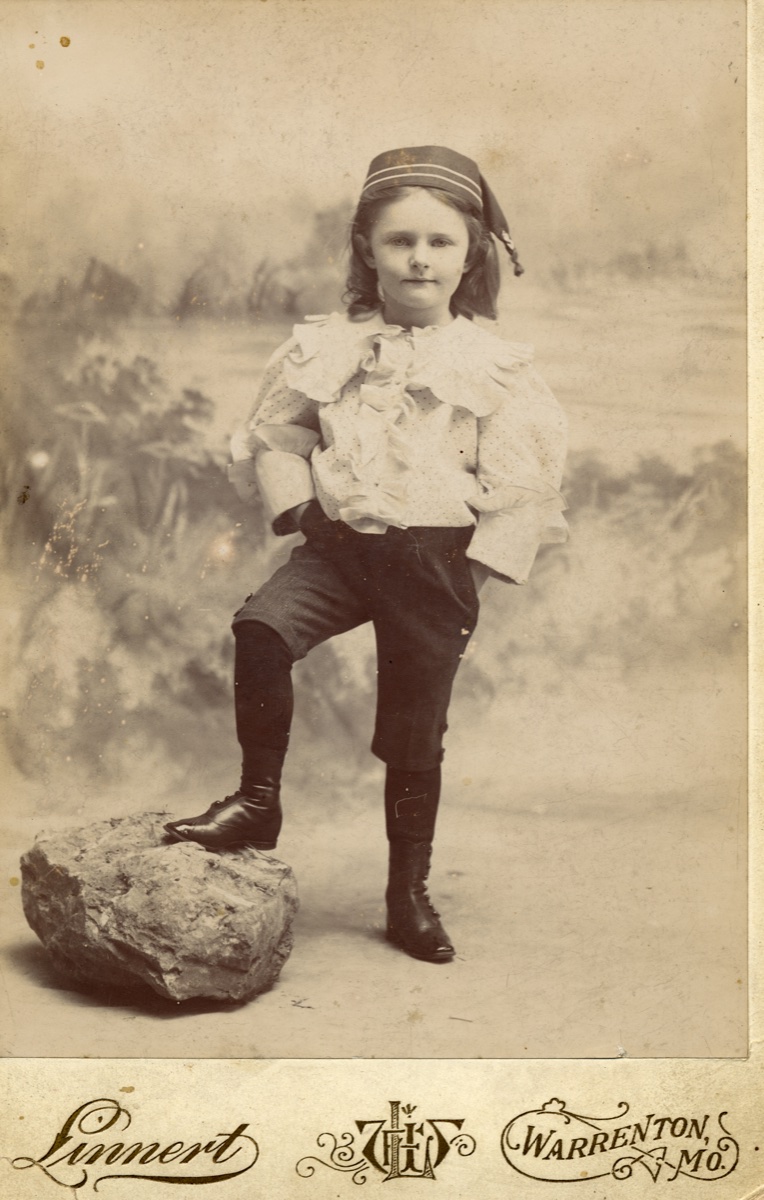
Mamie Martin was born in 18 March 1890 in Wright City, Warren County, Missouri.[163]
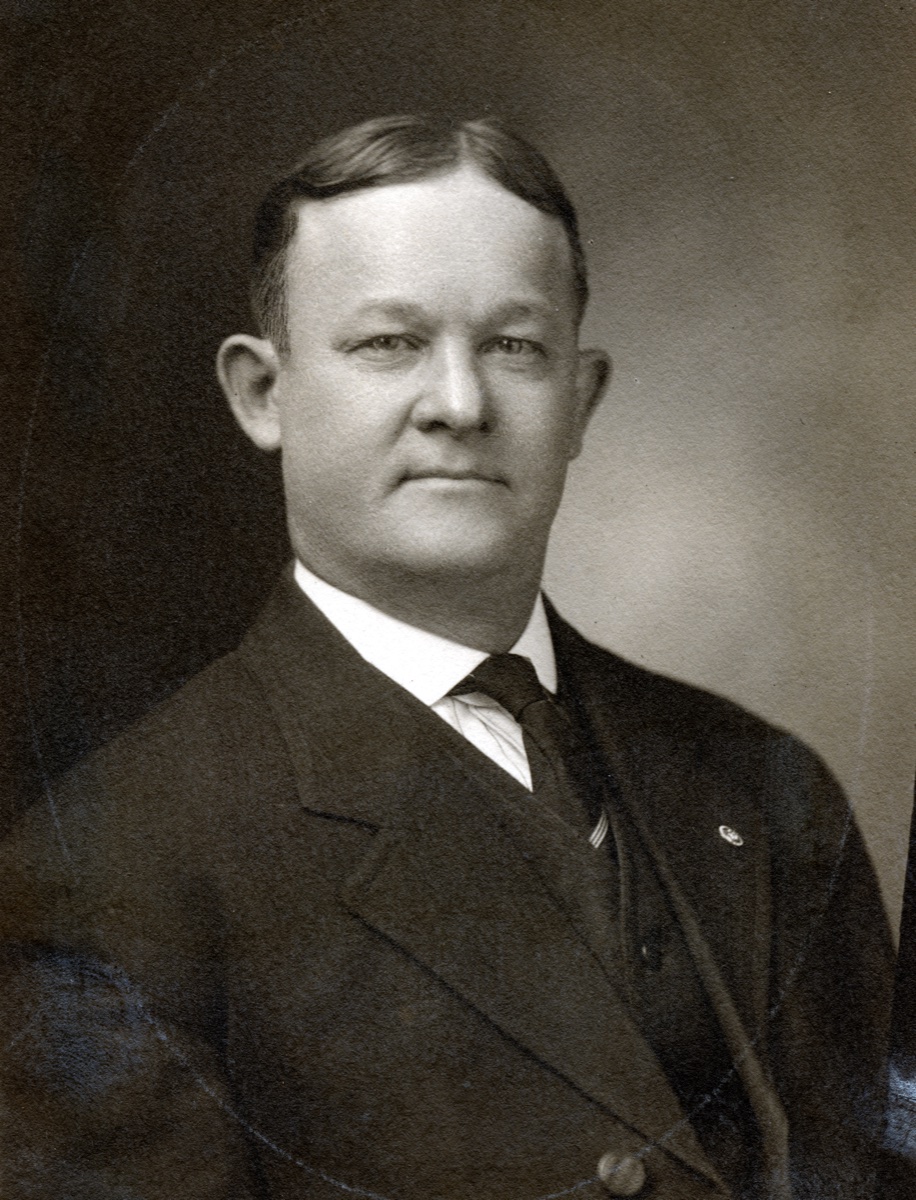
She married a widower, James Burge, in Jacksonville, Morgan County, Illinois on 21 January 1915.[164] [165] [166] She would be 25 in a few weeks. He was 45. Neither Mamie nor James had middle names.[167]
James was born 23 August, 1869 in Jacksonville.[168] He was the son of John Burge, who immigrated from England,[169] [170] and Sarah Neal.[171] [172] [173] In 1903, James first married[174] Hattie Swisher who died in 1904,[175] in childbirth. They had a son, James Burge, Jr. who lived in Tuscola, in 1962.[176] James, Jr., had a son, David Burge.[177]
In the 1920 census, James, Mamie and their daughter, Aileen Linn, are living in Jacksonville.[178] James owns a grocery store.
James Burge died 23 May 1962 at the grand age of 92. His wife Mamie Martin Burge died six years later, 16 September 1968 aged 79, six months before her (unknown to her) sister Bettie. James and Mamie are buried in Diamond Grove Cemetery, in Jacksonville, Illinois.[179]
James’ obituary reads: [180]
Veteran Grocer, James Burge, Dies; Funeral Saturday. James Burge, veteran grocer in Jacksonville, who retired in 1960 at the age of 90, died at 2:25 a.m. Wednesday at Passavant hospital where he had been a patient since May 8th. Mr. Burge resided at 1022 West College Avenue. He owned and operated a grocery store on the corner of South Church and Anna streets from 1907 to 1960, having started in the retail grocery business in 1903. A lifelong resident he was born in Jacksonville August 23, 1869, the son of John and Sarah Neal Burge. He was the last of his immediate family. He was married in 1903 to Hattie Swisher and she died in 1904. On Jan. 21, 1915, he married Mamie Martin who survives with a daughter, Aileen, wife of Roy A. Wright, Jacksonville and a son by the first union, James Burge of Tuscola. A grandson David Burge also survives. Mr. Burge held membership for over 50 years in the IOOF Lodge No. 4 and the Knights of Pythias Lodge of Jacksonville. He united with the Methodist church at an early age. The body was taken to Williamson Funeral Home where the family will meet friends 7:30 to 9 p.m. Friday. Funeral services will be held at 2 p.m. Saturday at the funeral home with Rev. Gerald Miller of First Christian church officiating. Interment will be in Diamond Grove cemetery.
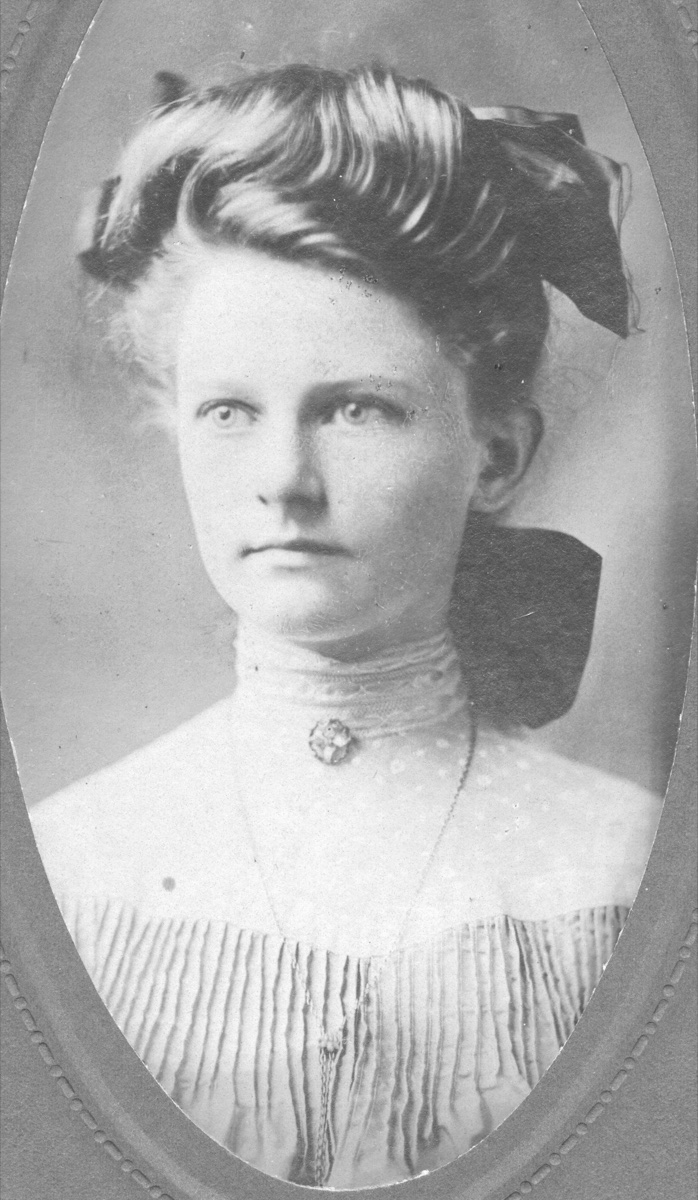
Mamie’s daughter Aileen wrote about her mother:[181]
My mother Mamie Martin Burge was very close to her father and mother. As a small child she rode horses with her father. Not with him on his horse, but alone on a big horse. She was thrown from one when she was three years old. After her father saw that she was not injured, he told her she must get back up on it or it would ruin her horse. He walked between the two horses, with a firm grip on hers, all the way home. (He raised and trained horses).When she was a little older she helped him in the garden. Fishing with him was her favorite thing. She loved animals-especially dogs and horses. She was chief telephone operator in Fulton, Missouri before she came to Jacksonville. A doctor in Fulton told the operators “when I am needed, you girls can find me when I don’t know myself where I am.” She enjoyed doing embroidery and crochet. She taught me to do cross stitch before I was old enough to go to school. When I was older she loved to work with flowers. Our yard was beautiful. We were a close family. Up to the time that I left grade school, we lived close to my father’s grocery store and the grade school. I spent a lot of time with my father. There were no school lunches then. In bad weather he would fix lunches for the children who lived a distance from school. They enjoyed that. They all loved him. When we moved to another location, we were not so close to the store. I spent lots of time with my mother. When I was not in school, we would hurry to get our house chores done, so we could work on our needlework projects in the afternoon. I have many wonderful memories of both my parents and my husband.
Mamie’s obituary reads:
Mrs. Burge, 79, Dies Tuesday, Funeral Friday. Mrs. Mamie Burge, 79, widow of James Burge and resident of many years at 1022 West College avenue, died late Tuesday night at Modern Care Nursing Home. Mrs. Burge was born March 18, 1890 in Wright City Missouri, the daughter of John and Mary Gregory Martin. She was married to James Burge Jan. 21, 1915, and he preceded her in death May 23, 1962. Surviving is a daughter, Aileen, wife of Roy A. Wright of this city, and one niece, Mrs. Alice Cowling, Kansas City Missouri. Two Sisters preceded Mrs. Burge in death.[182] The deceased was a member of Central Christian church. The remains were taken to Williamson Funeral Home, where the family will meet friends 7 to 9 p.m. Thursday. Funeral services will be at 3:30 pm Friday at the funeral home with Rev. William K. Sturgess officiating. Interment will be in Diamond Grove cemetery.[183]
Dick and Mary’s Granddaughter Aileen
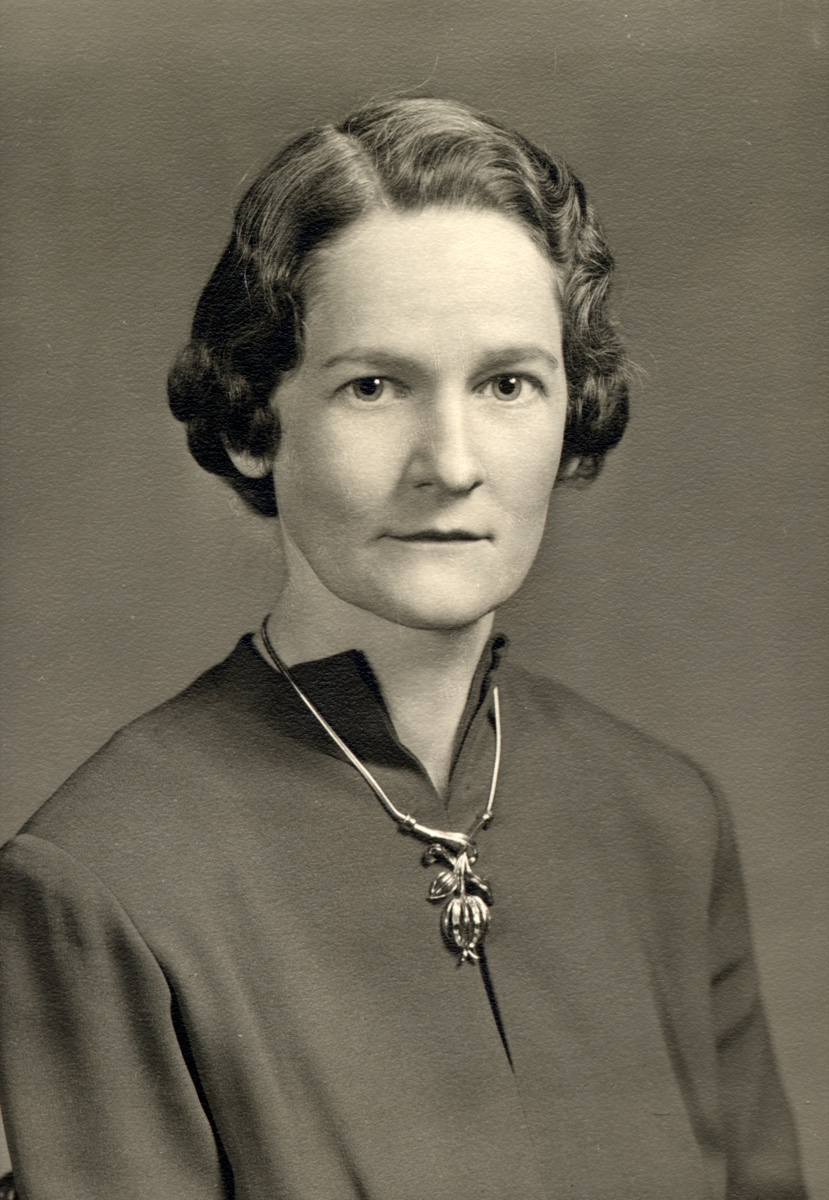
Mamie and James’ only child, Aileen Linn Burge, was born 19 November, 1915, in Jacksonville. She married Roy Andrew Wright, 26 August, 1951 in her parents’ home in Jacksonville. He was 36, she was 35.
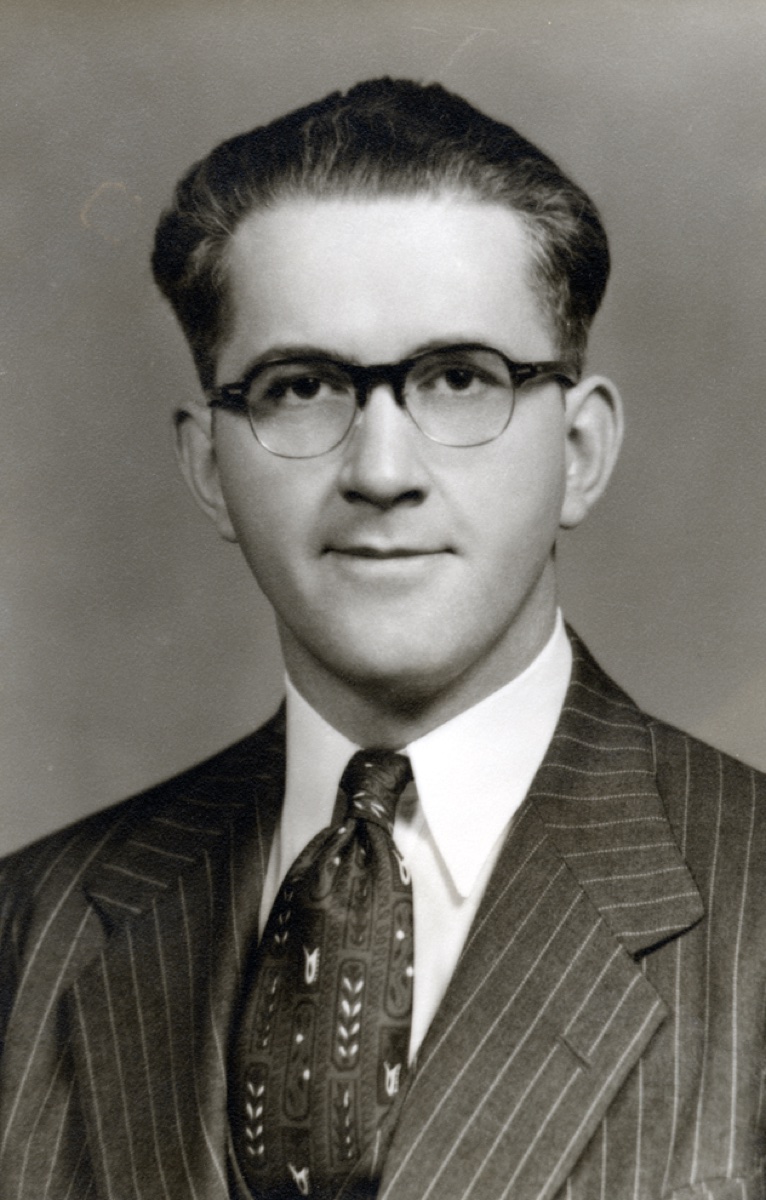
Roy was the son of Roy and Florence Griffith Wright. Roy was born 5 September, 1914 in Wrights, Green County, Illinois. He died 13 January, 2000, in Jacksonville, Illinois, aged 85. He is buried in Diamond Grove Cemetery in Jacksonville. [184]
Roy was a nurse. In June, 1966 he was appointed director of Nursing Service at Jackson State Hospital. The announcement included a biographical sketch:[185]
On June 9 [1966] Dr. Steve Pratt officially announced appointment of Roy Wright, R. N. , as director of Nursing Service at Jacksonville State Hospital. Mr. Wright has been associated with the Jacksonville State Hospital since November of 1935 when he was employed as a psychiatric aide. At that time the aide position involved a 48-hour work week at a salary of $50 a month. From 1941 to 1944 Mr. Wright served in the United States Army as a Sergeant in the Medical Corps. Following his service experience, he returned to the institution where he was briefly employed in the dietary service as the “ice cream man.” In 1948 he entered Our Saviour’s School of Nursing, graduating in 1951. For the next three years he was on the faculty of the Psychiatric Nursing Affiliation at Jacksonville State Hospital. In 1954 Mr. Wright entered Washington University in St. Louis where, in 1956, he received his Bachelor of Science degree in Nursing. In April of 1957, Mr. Wright was appointed assistant chief nurse at Jacksonville State Hospital where he has remained until his promotion to the position of director of Nursing Service. Mr. Wright is married; his wife, the former Aileen Burge, is a medical technologist. She will begin teaching science at Jonathan Turner junior High School this fall. As a hobby, Mr. Wright refinishes and restores antiques. In his nursing duties as director, Mr. Wright will be coordinating the Nursing Service for the entire hospital. At the present time, he is involved with interviewing prospective employees in an effort to secure adequate Nursing Service personnel to staff the new centers and to upgrade services in the Medical-Surgical and Geriatric Units. Mr. Wright is a member of the Unit System Study and Planning Committee where he contributed his experience and knowledge in preparation for M- Day when Jacksonville State Hospital created four major treatment centers and transferred about 1500 patients to residential units corresponding to their counties of origin. “As the centers begin to develop administrative techniques and new programs,” Mr. Wright said, “Nursing Service will make every effort to cooperate with other disciplines in planning and implementing procedures which will establish Jacksonville State Hospital as a leader in the mental health field.”
Aileen had a long career as a medical technologist. In 1955 she was chosen as president her professional association:[186]
Mrs. Aileen Burge Wright was chosen as president-elect of the Illinois Medical Technologists Association, according to the announcement made at the semi-annual meeting of the Association in Chicago on May 4. Mrs. Wright, 328 Sandusky street, is the Bacteriologist at the Jacksonville State hospital. She has been active in Association work and in 1954 was honored by receiving the first award in bacteriology -offered by the Scientific Products Foundation at the annual meeting of the American Society of Medical Technologists.
In 1958 Aileen became the chief bacteriologist at Passavant Hospital:[187]
Mrs. Aileen Burge Wright, for 15 years bacteriologist at the Jacksonville State Hospital, has accepted the post of chief medical technologist in the laboratory of Passavant Memorial Hospital. A graduate of Illinois College, Mrs. Wright has completed graduate training in technology at the Medical School of Northwestern University where she also served as an instructor. In addition to her full-time schedule at Passavant hospital, Mrs. Wright continues to teach a course in microbiology at Illinois College. She is an associate editor of the American Journal of Medical Technology, and also serving as a judge for papers on bacteriology for the Scientific Products Foundation. In 1957 Mrs. Wright was state president of the Illinois Medical Technologists Association, in which she remains active, and she is a member of the American Society of Medical Technologists. She was the first president of the Springfield District of the IMTA. A published paper on the “Isolation and Identification of Enteric Bacteria” won an award for Mrs. Wright in 1953 from the American Society of Medical Technologists and also from the Scientific Products Foundation.
In 1960 Aileen was honored with a national award:[188]
Mrs. Aileen Burge Wright, chief medical technologist at Passavant Memorial Area Hospital, has been nominated for the Corning Award by the Illinois Medical Technologists Association. This is a national honor for which all of the state societies submit a candidate for the line medical technologist of the year. The winner of the award will be announced at the American Society of Medical Technologists convention in Atlantic City, beginning June 19. Mrs. Wright has been chosen to represent her state because of her outstanding work as a medical technologist and for her contributions to her local and state organizations. She was the first president of the Springfield Branch Society and has served in various other capacities in the local medical technologist organization. She served as president of the Illinois Medical Technologists Association and has held many positions in that society. At present she is on the editorial board of the American Journal of Medical Technology.
Roy and Aileen both retired in 1974.
Aileen visited Fauquier County with her mother when she was only three years old. She remembered visiting the Martin Family Cemetery. She saw Josh Martin’s tombstone and noted that Billy Bowen’s grave was outside the stone wall containing the other graves. She also remembers visiting her cousin, Ernest Lee Childs and her mother’s aunts Betty Bowen and Minnie Martin.
In 2005 Dick Martin’s granddaughter, Aileen Linn Burge Wright, aged 89, lives in Jacksonville, Illinois. She has no children.
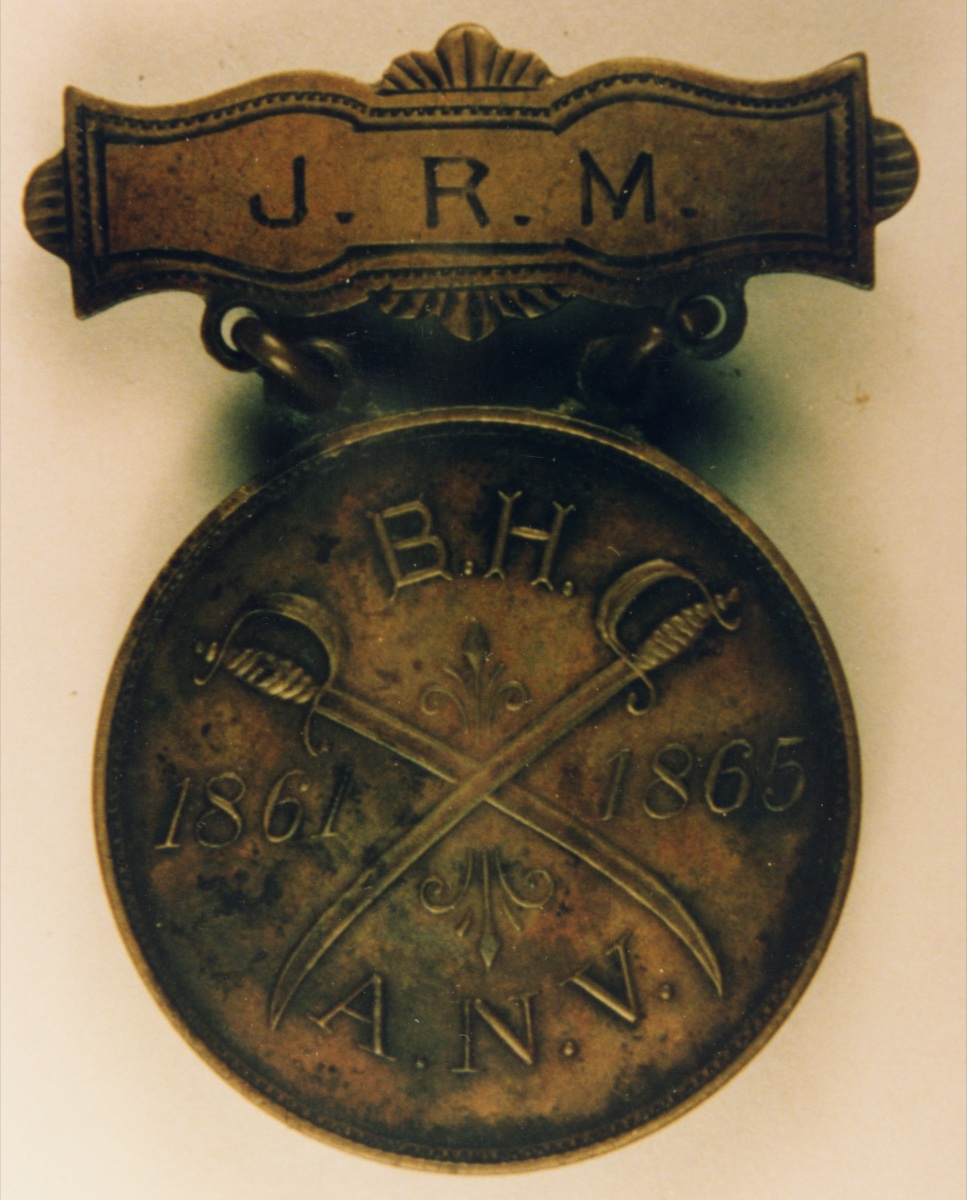
Dick’s Confederate Veterans Activities
Dick was active in various Confederate veteran affairs. In 1899, the Missouri Telegraph reported on a veterans meeting:
Ex-Confederates Meet and Discuss the Exploits of Other Days. J. H. Martin, of Mexico [in Audrain County, Missouri], who served under Gen. Lee on the Lower Fauquier River in Virginia, and so was a private in the “Black Horse Troop,” with the assistance of a comrade, captured the advance guard of fifteen, confined the arms and marched then prisoners to the out-post of the enemy’s camp and then with a rebel yell, “took to the pines,” and escaped. Some pranky veterans suggested Mr. Martin was the one made prisoner and that he made his escape at the northern pickets, but the joke could not account for Mr. Martin’s possession of fifteen northern soldiers.[189]
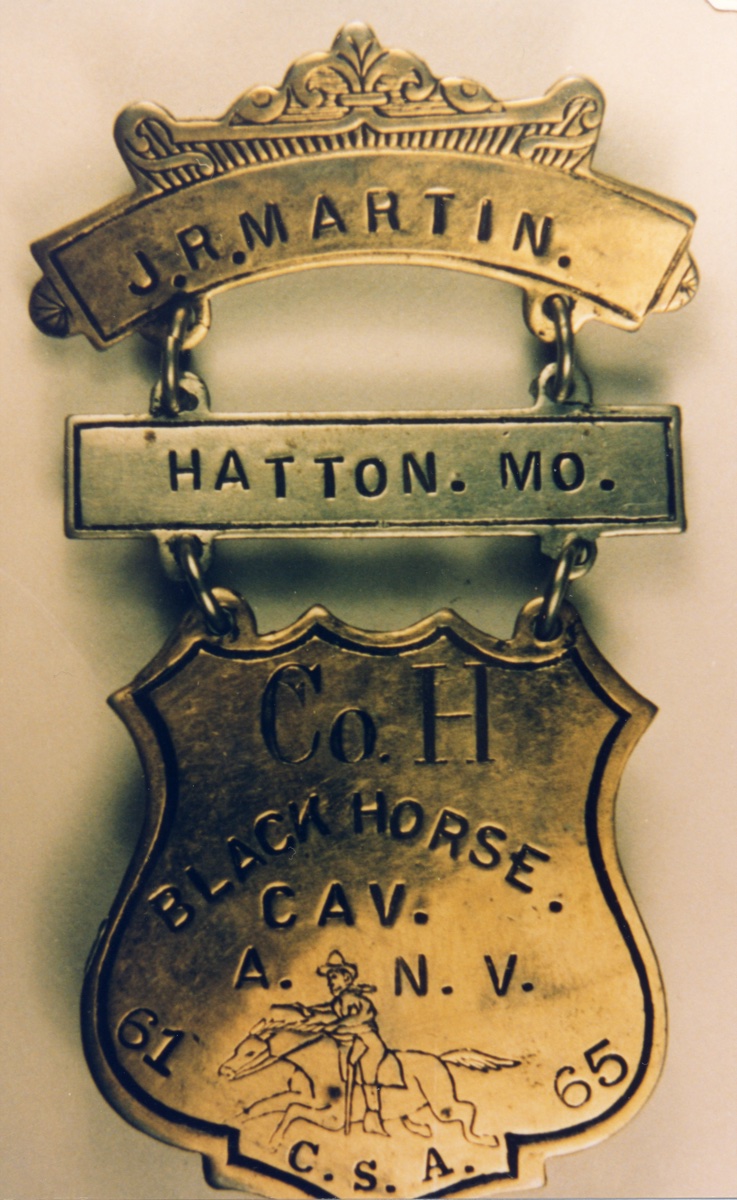
Pension Application
On 23 June 1913, at age 72, a few months after the death of his wife Mary, Dick applied for a Confederate veteran’s pension. He was living in Fulton at the time. He got a pension of ten dollars a month.[190] His application was accompanied by the following affidavit:
We the undersigned, surviving members of the “Black Horse Company” having learned that our comrade, J. Richard Martin is now a resident of Hatton, Callaway County, Missouri, in a community of friends with whom he is naturally solicitous to establish himself as a soldier of the Confederate States, hereby certify that we are familiar with career as a member of our troop, and his services as a private from the war’s beginning to its close; welcome an opportunity to attest that he was among the foremost of our comrades for courage, enthusiasm in the performance of duties and in cheerful endurance of the perils and hardships in field and camp, we further know that his manly bearing under circumstances, encouraged others to similar bravery in battle, fortitude on the march and under all dangers and trials. His two brothers Robert E. and George W. Martin, constituted a trio unsurpassed in all the qualities of patriotic soldiers and they were together so distinguished for Knighthood, it was impracticable to discriminate between them. When the Rifle was sent by a distinguished Englishman and admirer of the Confederates to be presented to the most splendid soldier of the “Black Horse,” it might have been given with justice to J. Richard Martin as well as to his older brother. We can further say the entire Martin family, consisting of father, mother and three daughters, enlisted not less zealously, than the three brothers and had all the families of the Confederacy imitated their splendid example the Stars and Bars would have been a victorious standard. Signed: James Keith, James Vass, M. M. Green, S. S. Jones, Jno. G. Beale, C. E. Holtzclaw, R. A. Hart, John K. Taliaferro, Hugh Hamilton. [191]
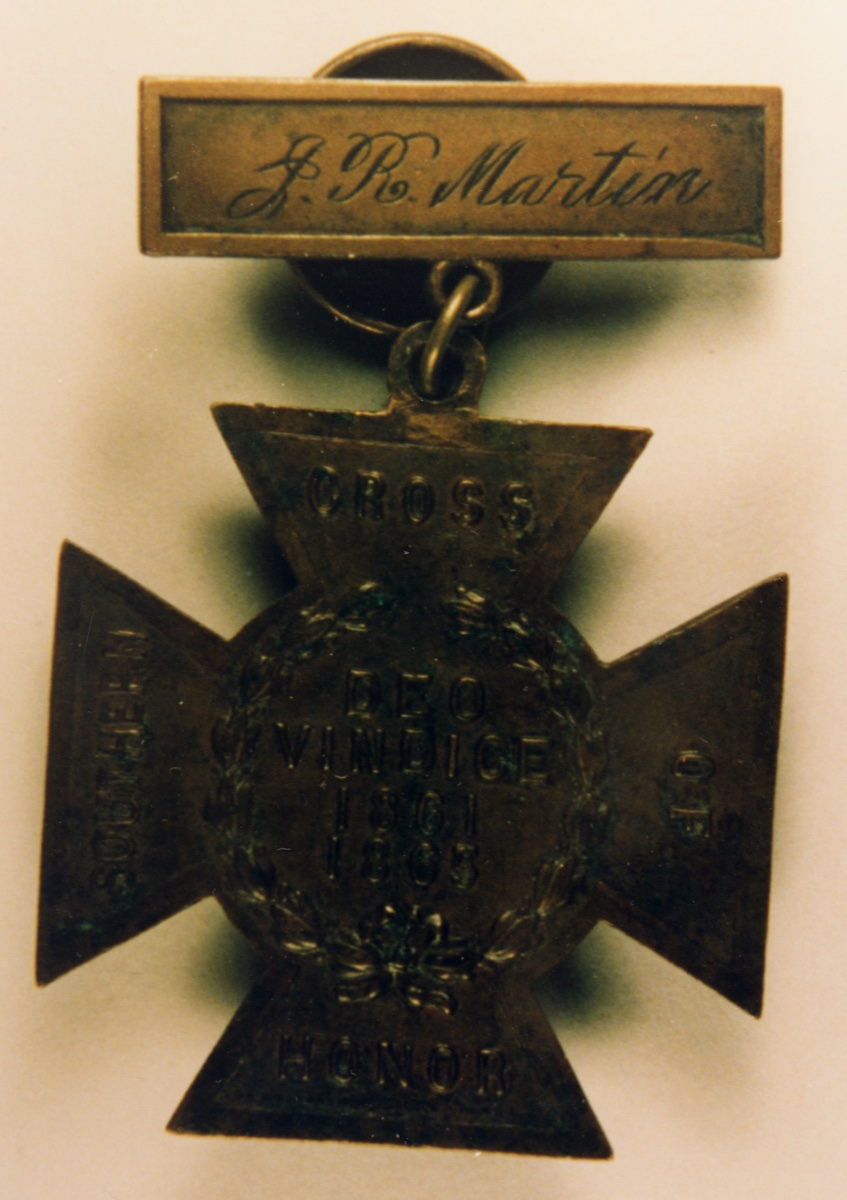
Southern Cross of Honor
On 7 November 1913, he completed a certificate of eligibility for the Southern Cross of Honor of the United Daughters of the Confederacy. It was also signed by his fellow Black Horse Cavalrymen, Hugh Hamilton and F. R. Duke, all members of Camp No. 91 of the United Confederate Veterans. A F. Rose signed as Adjutant. It said that when he enlisted, he was a resident of “Fauquier”; he was honorably discharged by “parole, April 1865, at which time he held the rank of Private.”[192]
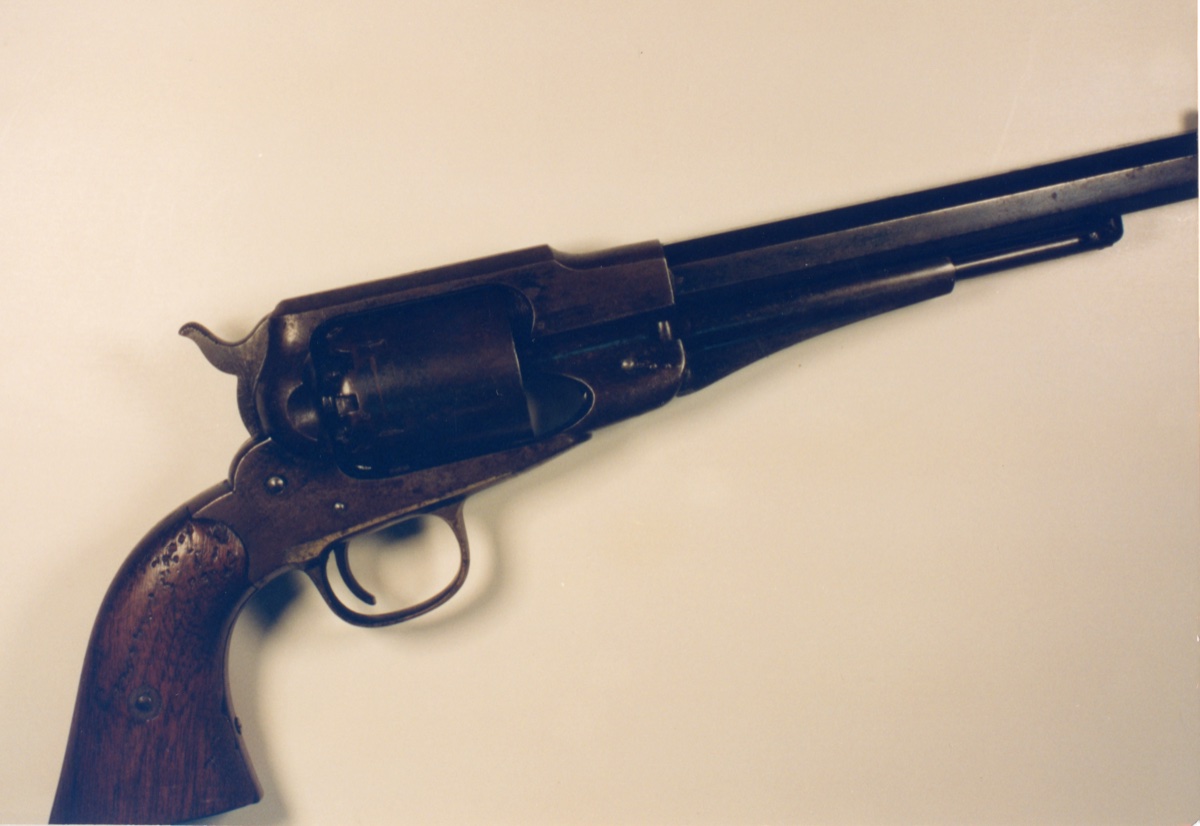
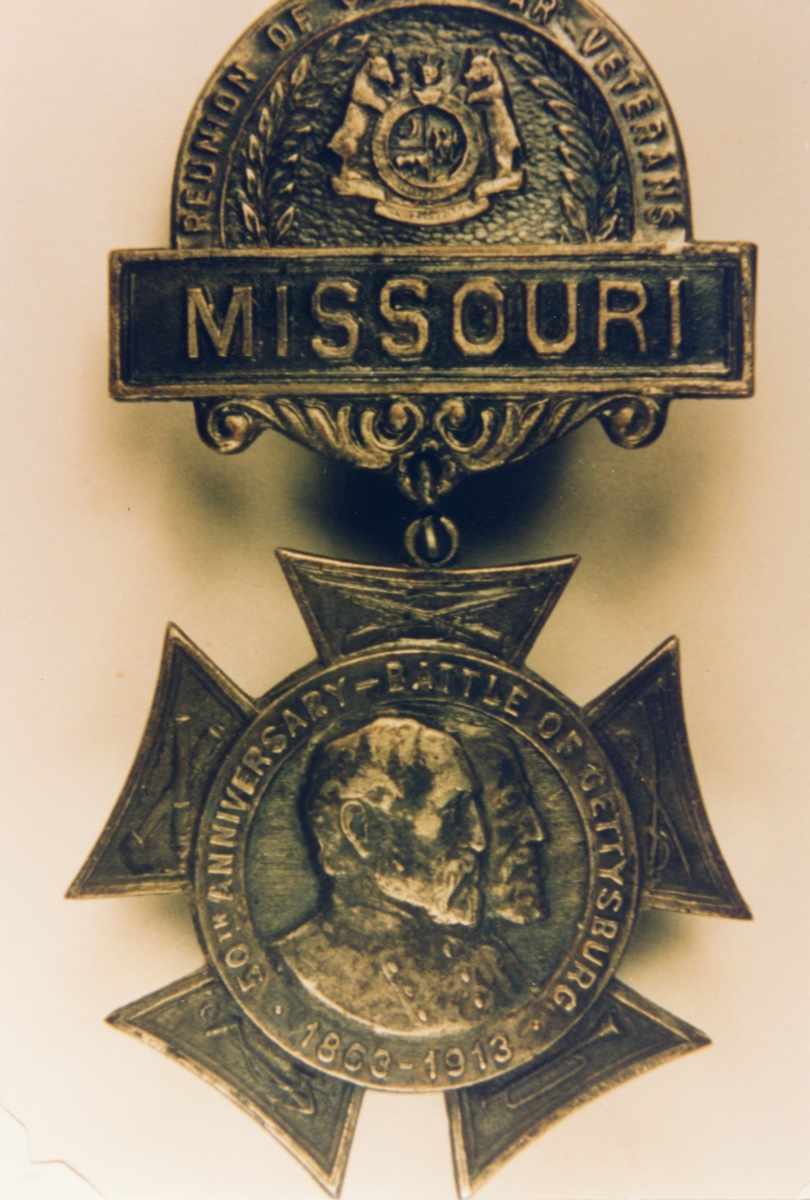
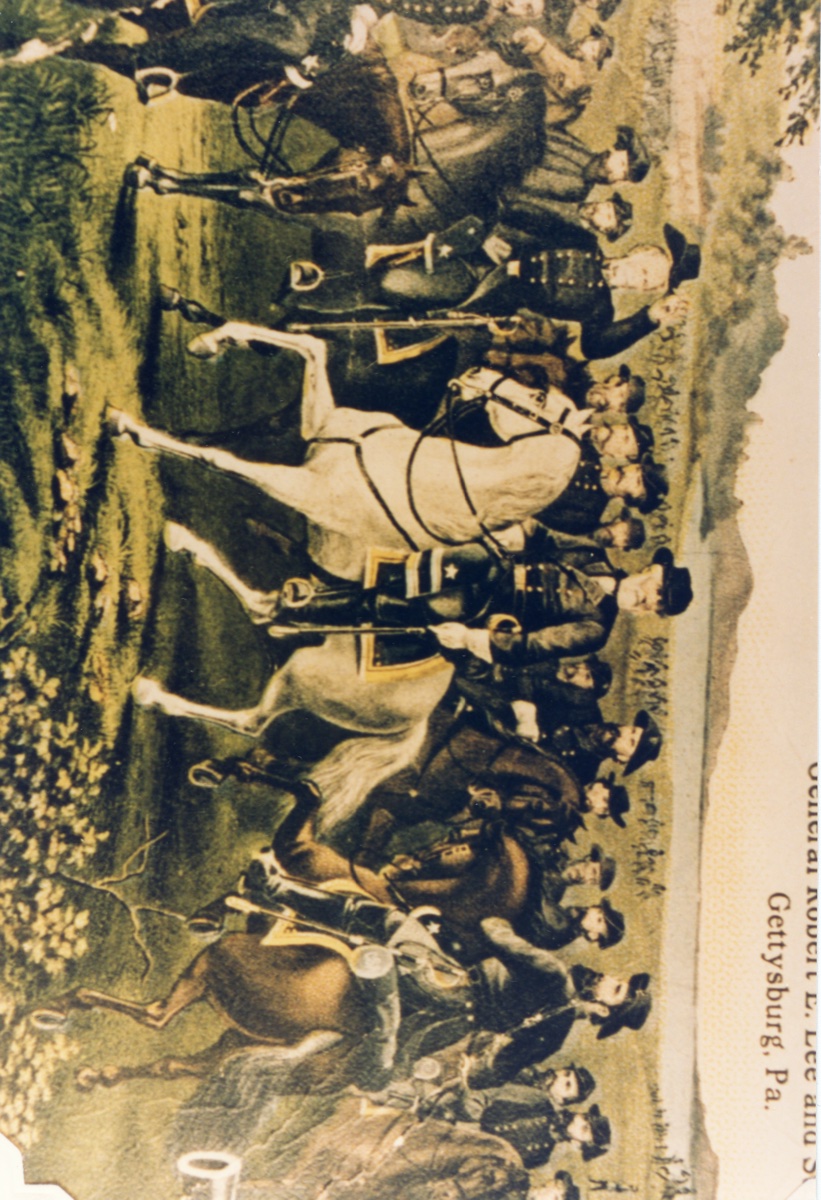
Attending the 50th Anniversary Reunion at Gettysburg
Dick Martin took the long trip to Gettysburg for the 50th anniversary and reunion, 1-3 July 1013.
Recognition of Dick Martin’s Teaching Career
At age 68, in 1910, Dick Martin was recognized for his many years of teaching in the Fulton area and was the subject of a local newspaper article:[193]
PEDAGOGUE 44 YEARS FULTON TEACHER’S RECORD. Fulton, Mo., Oct. 8-J. R. Martin, familiarly known as “Uncle Dick” Martin, is the oldest school-teacher in Callaway County. Mr. Martin has been at the pedagogic game since 1866, and doesn’t allow such a small thing as 68 years to rest so heavily on his shoulders that he cannot administer to the wants of Young America five days in every school week of the year. He began teaching in Virginia in 1866, having charge of private schools for two terms of ten months each. He then came to Callaway County. Since that time he has taught in Callaway, Boone, Audrain, Montgomery, Warren and Lincoln counties dividing his time almost equally among the six counties. He is at present teaching his fifth term at the Craig School, four and one-half miles north of Fulton, four of which have been consecutive. For several years Mr. Martin had a worthy contender for first honors as being the oldest teacher in the person of J. A. Padgett of New Bloomfield, who retired last year. The two men are practically of the same age and taught schools in adjoining districts in Warren County in 1870. Since then, however, they have been’ widely separated in their fields of labor. Mr. Martin makes his home in Fulton and spends his leisure time in keeping up his acquaintances in this city. He has kept pace with the new wrinkles in the educational lines as the years rolled by.
Dick’s Last Years
In 1916, Dick developed heart trouble and, with his wife Mary two years dead, he decided he wanted to spend his last days at home in Fauquier County. For twenty-two years Dick was the only survivor of his brothers. At the age of 74, he went home to Fauquier to die.
On the way, he stopped to visit his daughter Mamie, who took him to a doctor. The doctor told Mamie not to let him go to Virginia because she would probably never see him again.[194]
He stayed with his sister Minnie and her servant and companion, Susan Moore, at his former residence on the “Home Farm.” One day, Minnie looked at him lying in bed, and said to Susan, “he looks very peaceful.” Susan replied, “Yes, he just died.”[195] It was 5 January 1916, three years after the death of his wife Mary.[196] Dick is buried in the Martin Family Cemetery, grave unmarked.
Dick Martin’s obituary in the Fauquier Democrat newspaper read:[197]
J. Richard Martin died at the home of his sister Miss Minnie Martin of near Casanova, 25 January, 1916,[198] and was buried the following day at the Martin home, now owned by W. M. Groves and S. W. Strickler.[199] Services were conducted at the home and also at the grave by the Rev. Mr. Marshall. Dick Martin, son of Honest John Martin, was one of the famous Martin brothers, members of the Black Horse Cavalry, Bob and Josh having both preceded him to the grave. He was in the 75th year of his age. He had made his home for a number of years in the State of Missouri, and returned about six months ago to the home of his sister, Miss Minnie, in impaired health, to spend the remainder of his life in his dear old home. He is survived by two sisters, Miss Minnie [Mildred Lee] Martin and Mrs. Wm. A. Bowen [his twin, Bettie]. He will always be remembered by the survivors of his comrades as one of the bravest of the brave. Comrade.
Another obituary noted:[200]
Richard Martin Dead. Departed this life on January 5th, 1916, at the residence of his sister Miss Minnie Martin, near Casanova Fauquier Co, Va., J. Richard Martin in the 75th year of his age, after a protracted illness which he bore with patience and fortitude. Another true and brave Confederate Soldier has responded to the roll call of the Spirit Land, and the few survivors who were associated with him as a soldier boy, and in his early life after the war, before leaving his native county to seek a home in the far West, are called to mourn the loss of a noble comrade, congenial associate, and one whose friendship never failed. Dick Martin (as he was familiarly known) was the last of a Trio of Brothers, whose devotion to the Southern Cause, and true courage as Soldiers, if equaled, could not be excelled, as was attested by the confidence reposed in them by their officers, the admiration and esteem of their comrades, and the dread and respect of their armed foes, for it could be truly said of them, that where duty called they were prompt to obey, and in the midst of conflict where the steel flashed brightest, and the bullets flew thickest, there were the Martin boys to be found. Dick enlisted in the Black Horse Cavalry at the commencement of the war, was afterward attached to the 4th Va. Cavalry as Company H., he served actively in the ranks, until disabled by a severe wound. For a short period he was in the Mercantile business at Rappahannock Sta. after the close of the war, but a devastated country afforded very little promise for a livelihood, and he sought the fertile, and prosperous State of Missouri, where he turned his attention to the education of the young, and stood well as a teacher, until his health failed, and about six months ago returned to the home of his birth, childhood, and early manhood to die, and be laid to rest with his parents, and those of his loved ones who preceded him. It was the writer’s pleasure to spend the day with him at the quaint old family home-stead which has undergone few changes in appearance since the war; he was reminded of the unsurpassed hospitality dispensed at that home, where no Southern Soldier was ever turned empty away (thought the supply of provision was very scant) or refused shelter under its welcome roof. In closing, the most comforting and important thing to be considered, is that he trusted in his God for the Salvation of his Soul, and the hope that his earthly suffering (which was for a season) has been changed to that of comfort, rest, peace, and happiness which Heaven alone can supply. May the memory of the Patriotic Old Parents ever cherished and Heaven’s richest blessing rest and abide with the surviving Sisters (who sacrificed so much, and experienced such hardships in a country over run by the enemies of those they loved, and sustained in every extremity) is the prayer Of a Comrade.
Thus, with Dick’s death, fifty-one years after the war, the last of the Martin boys was gone. Ninety years after his death, his ninety-year-old granddaughter Aileen is the last of his line.