From Germany to Germantown
Our nineteenth century family begins with “Honest” John Martin and his wife Susan A. Fisher, the parents of the Martin Boys. However, John Martin’s ancestors came to Virginia much earlier. Fauquier County’s Crocket Park, on Meetz Road, is the destination of thousands of visitors each year as they fish and swim in the beautiful lake and stroll though the woods. Hardly any know that they are in the middle of one of the earliest settlements in Fauquier. The lake dam is about where the colonists’ grist mill was located. Only a few hundred yards northeast, just outside the park boundary, lies the cemetery believed to contain the graves of some of the settlers. But, before the colonists came to Fauquier, they had been in Virginia for a few years, nearby.
The Immigrant: John Joseph Martin
The Martin[245] boys descended from John Joseph Martin, a 1714 immigrant from Germany to Virginia who settled first in the Germanna colony near the Wilderness on the Rapidan River in what is now Orange County, Virginia.
The First Colony at Germanna
There has been a good deal of research on this small group of Germans who were brought to Virginia as part of a scheme to mine precious metals. Their story is fascinating.[246] [247] [248] [249] [250]
In 1709, hundreds of Palatine refugees from the Rhineland had been driven from their homes by famine and religious persecution. Therefore, they sought refuge in England. Under the Swiss Baron Christopher de Graffenreid, some of these people were settled on the Neuse and Pamlico Rivers in North Carolina. When Baron de Graffenreid returned to Europe, Lt. Governor Alexander Spotswood requested him to recruit for him some German miners. Graffenreid persuaded 14 individuals with families totaling 42 persons from the town of Siegen and Muesen in the principality of Nassau- Siegen, Germany to come to Virginia. The First Germanna Colony arrived in Virginia at Tappahannock in the spring of 1714, and then came up the Rappahannock River where they settled 20 miles west of Fredericksburg at a location that would be called Fort Germanna.[251]
Germantown, Fauquier County, Virginia
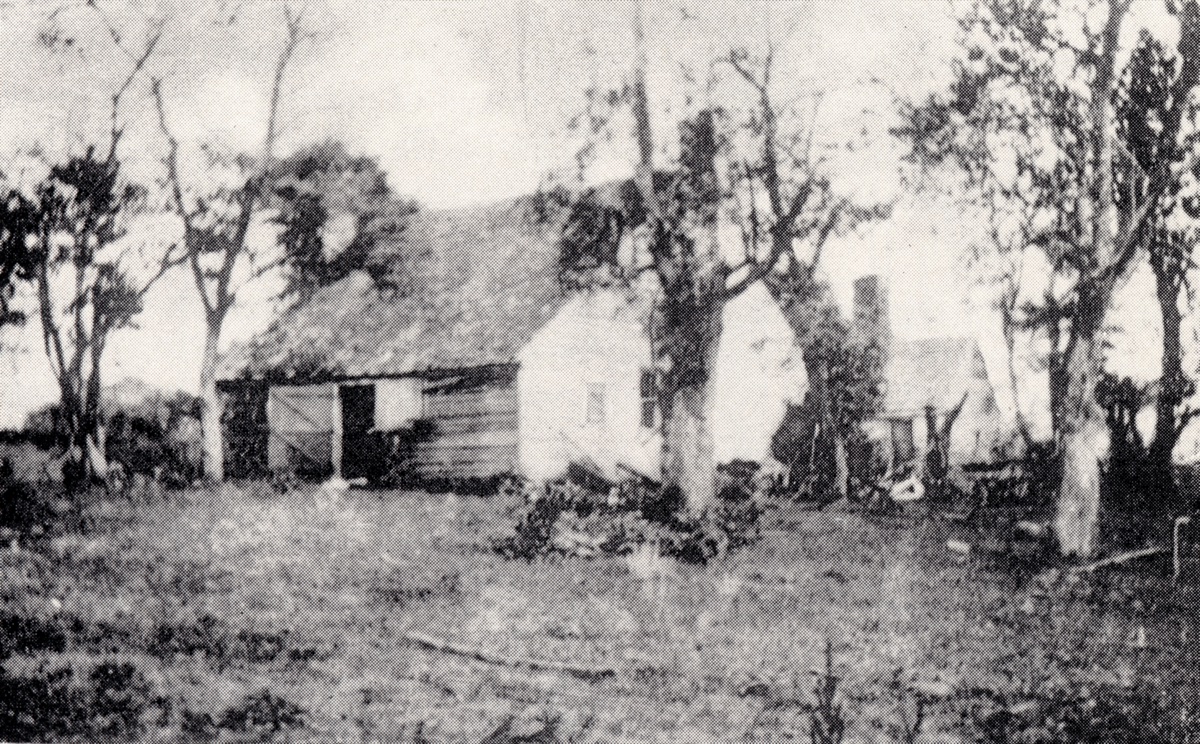
Some of the colony then moved to Germantown, about nineteen miles north, now in Fauquier County, but then in Stafford and later Prince William County.
By 1718, differences arose between the governor and the Germans, so the colonists purchased 1,805 acres of fertile land lying further into the Virginia wilderness. They packed all of their provisions on their heads, traveled northward along an old Iroquois trail, and settled upon their new homeland in what is presently southern Fauquier County. It was agreed that the property and its expense would be divided equally among the following settlers: Melchior Brumback, Joseph Coons, Harman Fishback, John Fishback, Peter Hitt, Jacob Holtzclaw, John Henry Hoffman, John Kemper, John Joseph Martin, Jacob Rector, John Spilman and Tillman Weaver. Lots were drawn to assign the rectangular parcels of farm land. Homes were built on the southwestern side of Licking Run which flowed through every farm. The settlement was named Germantown. Being devout members of the German Reformed Church, each landowner also agreed to donate ten acres to form a glebe whereupon Fauquier County’s first church, parsonage, and school were constructed. Agriculture was practiced in the feudal German tradition with the exception of their cultivation of tobacco. A grist mill and a saw mill were soon in operation. German Rolling Road was built for easier transport of their plentiful goods and crops to the-Falmouth market.[252]
John W. Wayland gave the most extensive description of the Germantown colony:
This tract was divided into twelve equal portions, but evidently the families did not at once distribute themselves upon them. They were still on the frontier and knew not what dangers they might apprehend from hostile tribes of Indians. They no doubt remembered how people in many parts of Europe had sought safety in times of danger. Today, on a hill overlooking Licking Run and the fertile fields bordering it, are the marks of a number of cabins that stood near together. Perhaps a palisade surrounded them. Here, we may believe, the hardy pioneers first lived, going out to their fields in the daytime and returning at night. As time passed and greater safety was assured, the several families erected dwellings on their respective farms. For a season at least they continued to enjoy the special immunities from public and county levies that had been granted them at Germanna. They were still on the frontier and had a defensive value to the older settlements. Appropriately, the village, the settlement, was called Germantown. The locality had natural advantages and evidently had been selected with care and foresight. There is a considerable portion of bottom land along the stream; the higher fields are well drained, but not much hilly. Licking Run is a good-sized stream and provided a good site for a grist mill, sawmill, and other operations to be run by water power. At several places there are ledges of stones that are impregnated with iron, and this probably had a good deal to do with the settlers making choice of this spot. It is doubtful, however, whether they ever found this ore very profitable. In a grove on an elevation near the present Hinegardner home is an old graveyard, and it is probable that the church and possibly the school house stood there. All of the graves but one are marked with small rough stones. The one exception is notable—over it are broad, heavy slabs of reddish-brown stone, with tall rounded-top slabs of the same kind upright at head and foot. Evidently this is the grave of some person of unusual distinction, and we may well believe it to be the tomb of Pastor Haeger, who died in 1737, at the age of 93. To this date (1956) no inscription has been discovered. Not far from the southeast corner within the 1800-acre tract, now a short distance south of the railroad, is a monument marking the birthplace of Chief Justice John Marshall, who was born here on September 24, 1755. … Germantown, long since, has been a “deserted village.” Its name is no more on the maps. Midland is near the site; Bealeton, Opal, and Calverton form a triangle enclosing it. But Germanna and Germantown both allure the feet of pilgrims who honor courage and devotion and cherish a goodly heritage.[253]
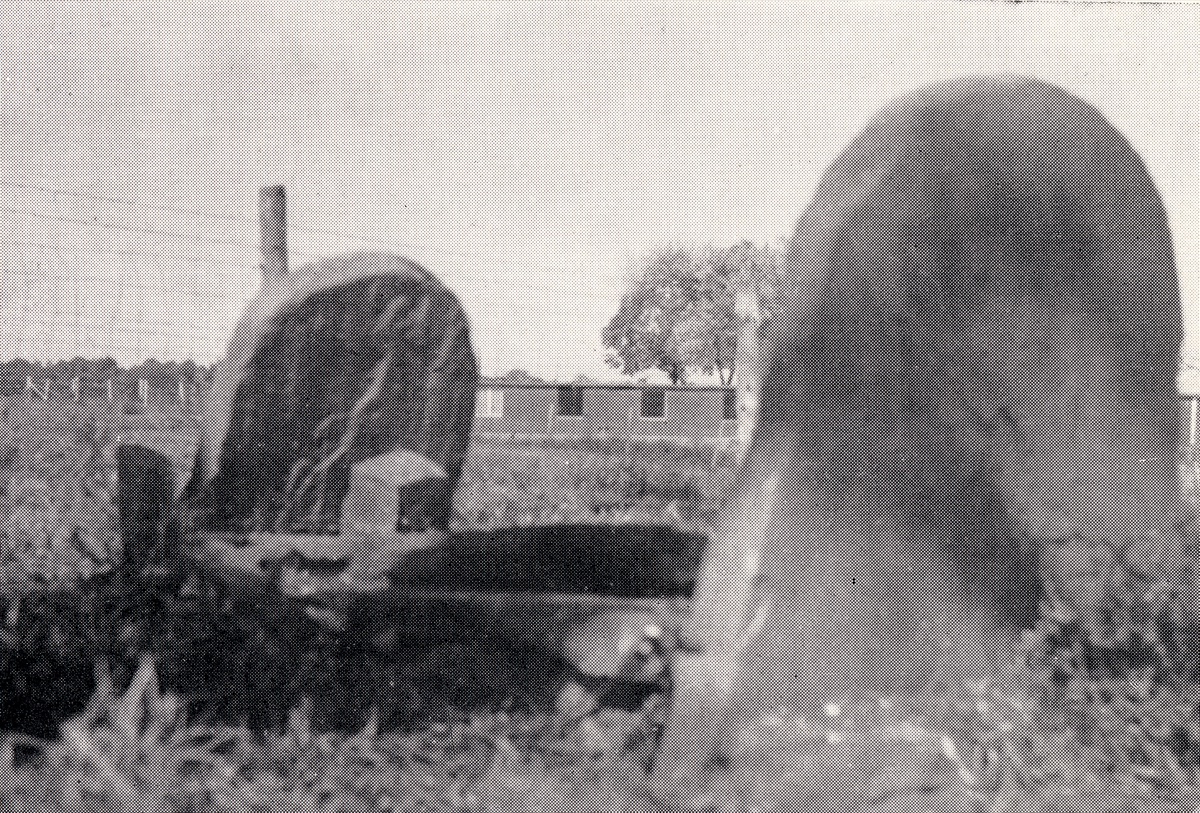
Good land could be acquired easily in Virginia, and was a family’s primary asset. According to author William Martin: [254]
Germantown’s settlers prospered; however, this good fortune resulted in acquisitions of abundant land elsewhere. By the time of the Revolution, nearly all of the original-settlers of Germantown had relocated.
What Kind of People Were They?
William Martin describes the middle class roots of the colonists:
One question which interests descendants probably more than who their ancestors were, is what sort of people where they? The statement these immigrants “were miners from Nassau-Siegen” may be somewhat misleading and give us too low an opinion of their character and station in life. Many of them had grown up on farms, and probably had been engaged in mining and iron manufacturing in Germany, which is natural enough in the view of the fact these were the chief businesses of the Siegen District. These people have been referred to in other research as mostly mechanics and master workmen in their several trades. Most of these immigrants came from the middle class and were not mere laborers. John Kemper’s grandfather was a blacksmith at Muesen, who had prospered there and amassed landed property, and his father was probably a smith and a church elder. John Joseph Martin’s grandfather was an associated justice in the court of mines. John Jacob Rector’s father was a watchmaker… Rev. Henry Haeger was both a teacher and a minister… there is enough information to show they, and their ancestors, were prosperous middle class German citizens. Enough has been said to show our ancestors were the reverse of a poor lot in Germany, but their connections in American were just as respectable as they had been in Germany: One of Jacob Holtzclaw’s daughters married Jeremiah Darnall, a magistrate of Fauquier County and descendant of a long line of English gentry who had been settled for 200 years in the Northern Neck of Virginia. Jacob’s eldest son, John Holzclaw, and the latter’s son, Benjamin, married into the family of Brigadier General William Russell of Revolutionary War fame, and a family with aristocratic connections. John Fishback’s son, Josiah, married a daughter of the illustrious Thomas Nelson of Revolutionary War fame, and later Governor of Virginia. The Kempers married at an early date into the Lawson and Timberlake families, people of excellent standing in northern Virginia. And, many other descendants of our colony have made their mark. Arkansas Governors, E. W. Conway, J. S. Conway and H. M. Rector were descendants of John Jacob Rector and John Fishback. The Honorable R. R. Hitt, member of Congress from Illinois, descended from Peter Hitt. James T. Holtzclaw of Montgomery, Alabama, a brigadier general, and brevet major general in the Confederate Army, was a member of General Lee’s staff… Many other descendants of our colony have been lawyers, judges, ministers, university professors, etc., and have taken their places worthily in the life of this nation.[255]
The Colony Disperses
The colony gradually integrated into the Fauquier community. Author William Martin continues:
The colony at Germantown was never the center of a large German settlement, nor did it have many German neighbors, as was the case in Pennsylvania and the many German settlements in the Valley of Virginia. Prince William County and Fauquier County, were largely settled by English people. Probably our colony held together as long as the older people lived, and services in the church were held in German at least as late as 1748, and probably longer. However, the second generation began to lose its German. At least half of the children of the colonists, if not more, married English people. Even some of the colonists, themselves, married second husbands or wives who were English. So, the German identity of our colony was gradually lost, and probably by 1760 or 1770, there was little to differentiate the children and grandchildren of our colony from their English neighbors. They had become Americans, and many of them served loyally, and some with distinction, in the War of Independence.[256]
There are many descendants of the original Germantown settlers in Fauquier today. Extensive work has been done on their genealogies, including the Martin family.[257] [258] [259]
The Germantown Settlement Boundaries
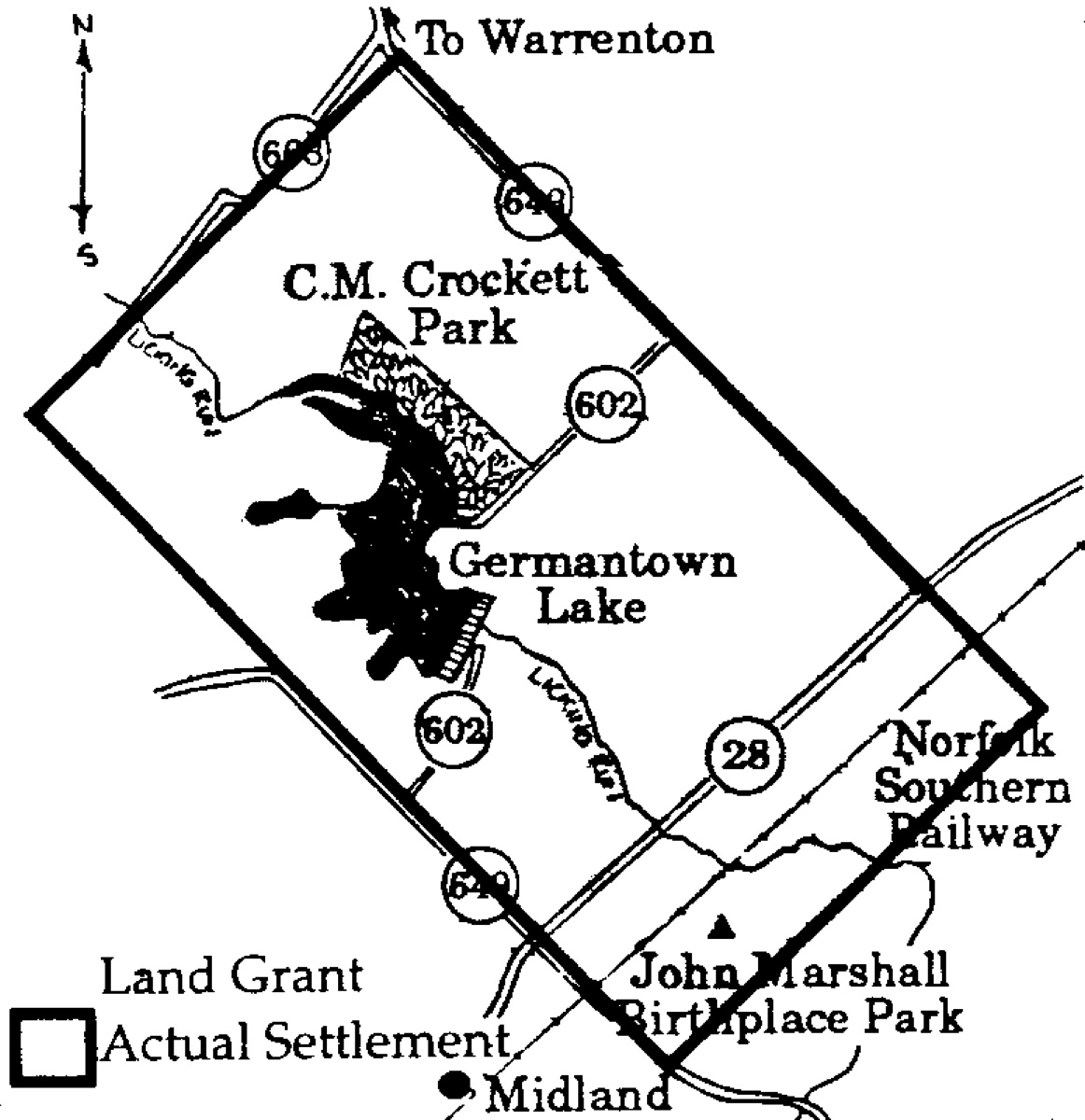
The Germantown settlement was located north of Midland with its southeastern corner abutting the Warrenton-Fauquier Airport. Fauquier County’s Crocket Park is toward the northwestern end of the tract. The park lake is on the site of the old millpond. Martin family genealogist William Martin noted: “The grant to our twelve families consisted of 1,805 acres on Licking Run (a creek) and is dated 2 August 1724. “The tract was a rectangle with the creek running pretty much across the middle of it from end to end …as late as 1936, was still called the Germantown neighborhood (.”[260] [261] [262] [263]
The map results from extensive research on the various land holding and transactions of the Germantown settlers. It is the most authoritative statement of the various land holdings and their owners.[264] The Hackley map is a significant improvement over another oft-cited map by Huffman.[265]
Wayland speculates that Lott 11 is probably where the settlers’ church and school stood. The graveyard contains a large tombstone that was perhaps the grave of Reverend John Henry Haeger, the religious leader of the settlement.[266] [267] [268] State route 602 no longer is a through road across the Germantown lots. When Crocket Part was built, the section of the road east of the dam was discontinued. With the exception of the park and the Route 28 corridor, the Germantown land is relatively undisturbed.